
1928 Alvis FD 12/75
Updated: Sep 8
The 1928 Alvis FD 12/75 brought together front-wheel drive, supercharging and four-wheel independent suspension in a remarkably low-slung chassis. The engineering was advanced, although servicing the inboard front brakes meant removing the entire engine and gearbox assembly.

Today, front-wheel drive is ordinary. In the 1920s, it was anything but. Alvis did not invent the idea but the small Coventry manufacturer became one of the companies most willing to find out what front-wheel drive could do in a high-performance car. What began with experimental racers and hill-climb machines eventually became a sports car that customers could actually buy.
From T.G. John to Alvis
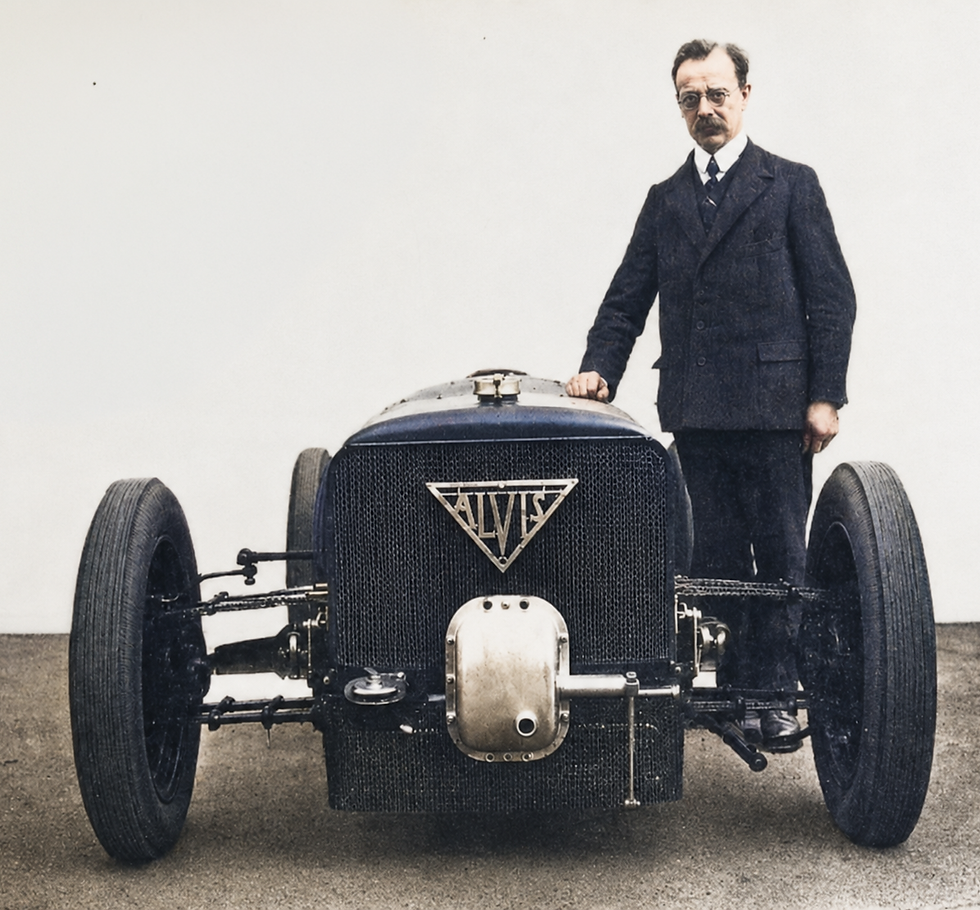
The company that became Alvis was founded in Coventry in 1919 by Thomas George John, a Welsh naval architect and engineer. T.G. John & Co. initially produced stationary engines and motor-scooter components before moving into automobile production. Its first car appeared in 1920 using designs developed by Geoffrey de Freville, who brought an advanced four-cylinder engine using aluminium pistons and pressure lubrication. Late in 1921, the company became the Alvis Car & Engineering Co. Ltd.
Two of the most important figures in the company's engineering history arrived in 1922. Captain George Thomas Smith-Clarke joined as chief engineer and works manager while William M. “Willie” Dunn became chief draughtsman. Both came from Daimler. Smith-Clarke shaped the broad engineering direction while Dunn translated those ideas into detailed designs that could actually be built. Together they would remain at the center of Alvis engineering for decades.
Their willingness to experiment would soon push Alvis far beyond the conventional sports cars of the period.
Experimenting With Front-Wheel Drive
By the middle of the decade, Alvis had already established a sporting reputation with the rear-wheel-drive 12/50. Instead of simply refining that formula, Smith-Clarke and Dunn began experimenting with driving the front wheels.
The reasoning was practical. Eliminating the long propeller shaft and rear differential allowed the major drivetrain components to be concentrated at the front. That opened the possibility of a lower chassis and a lower center of gravity, while the driven front wheels offered intriguing possibilities for traction and cornering.

Alvis's first front-wheel-drive competition car made its public debut at the Kop Hill Climb on March 28, 1925, where Major Maurice Harvey drove it to second place in its class. Shortly afterward the bright-yellow experimental car became known as “Tadpole.” Contemporary research describes the engine as essentially a 12/50 unit installed backwards, with the clutch, four-speed gearbox, final drive and differential arranged together and the front brake drums mounted inboard on the differential casing.
Alvis was not the first company ever to experiment with front-wheel drive. American engineer J. Walter Christie had raced front-drive machinery years earlier. Still, the timing of the Alvis project was remarkable. Its Kop Hill appearance came roughly two months before Harry Miller's famous front-wheel-drive racer appeared in the 1925 Indianapolis 500.

This photograph captures the low-slung Alvis No. 2 flashing past the stands, a glimpse into the speed and spectacle of British motor racing in 1927.
The experiments continued. Alvis built increasingly sophisticated 1.5-liter supercharged straight-eight front-wheel-drive Grand Prix cars for 1926 and 1927. The company's timeline records a FWD Alvis lapping Brooklands at 104 mph in 1925 and a straight-eight supercharged version reaching 121 mph in 1927. The cars were tremendously ambitious, although racing reliability did not always match their speed.
Those difficult racing seasons were not wasted. The suspension, steering, drivetrain layout and braking arrangements developed on the competition cars became the foundation for something more significant: a front-wheel-drive Alvis that could be sold to the public.
Racing Technology for the Road

For 1928, Alvis shifted its attention toward sports-car racing and production automobiles. The new four-cylinder FWD was not simply a conventional Alvis with the driveshaft removed. It was designed around front-wheel drive from the beginning.
Even the factory instruction book warns owners that familiar ideas about automobile layout no longer applied. With the exception of the rear suspension, nearly all of the working components were ahead of the dashboard. The engine, gearbox and differential were assembled as a single unit, and what would normally be considered the front and rear of the engine were effectively reversed.
At its heart was a 1,482cc four-cylinder engine with a single overhead camshaft. The camshaft and accessories were driven through an elaborate train of gears. One side of that system operated the water pump and magneto while the other drove the dynamo and, when fitted, the supercharger.
The naturally aspirated version produced about 50 bhp, while the supercharged specification raised output to approximately 75 bhp. The FD was the short-chassis blown version of the FWD family. Its Roots-type supercharger was itself a complex piece of equipment, with rotors carried on ball bearings and driven through a flexible coupling and gear train.
The engine also used aluminium-alloy pistons, continuing Alvis's early interest in reducing reciprocating weight.
Independent at All Four Corners
The chassis was just as unusual.
All four wheels were independently sprung, an uncommon feature on a production sports car in 1928. At the front, the road wheels were suspended by an arrangement of quarter-elliptic leaf springs while jointed driveshafts allowed each wheel to move, steer and remain driven at the same time. The factory manual describes the driveshaft entering a split hub housing and working through a spherical pivot arrangement as the suspension moved.
The front brakes were mounted inboard beside the differential rather than out at the wheel hubs. This reduced unsprung weight and helped the suspension respond more effectively to the road. Period accounts praised the braking system as remarkably powerful.

However, there was a trade off. Since the brakes were buried inside the front drivetrain assembly, getting to them was no quick feat. According to Alvis's own The engine and gearbox unit first had to be removed from the chassis before the brake drums could be opened.
Proving the Idea at Le Mans
Alvis had an unusually good opportunity to prove the basic design in competition.
At the 1928 24 Hours of Le Mans, two naturally aspirated FA 12/50 FWD cars were entered. These were close relatives of the production cars rather than FD 12/75s themselves, an important distinction when tracing the model's racing history.
Car No. 27, registration WK 5491, was driven by Major Maurice Harvey and Harold Purdy. It finished sixth overall and first in the 1.5-liter class.

Car No. 28, WK 5492, was driven by S.C.H. “Sammy” Davis and William Urquhart-Dykes. It finished ninth overall and second in the 1.5-liter class. Both Alvises completed the 24 hours, giving the company a first-and-second class finish with two radically unconventional new cars.
The historical Alvis Register still singles out the result as one of the great achievements of the company's FWD program.
Thirteen Seconds at the Tourist Trophy
Two months later came an even more dramatic race.
The RAC Tourist Trophy, held over the Ards road circuit in Northern Ireland on August 18, 1928, became a major test of Alvis's front-drive technology. The works cars had been substantially modified following Le Mans. Research into surviving Alvis records later identified these special Tourist Trophy machines under the mysterious internal designation FC rather than as standard production FDs.

The race was brutal. Several Alvises ran near the front before retiring with accidents or mechanical failures. Leon Cushman, driving car No. 32, kept going.
After almost six hours, Kaye Don's supercharged Lea-Francis won in 5 hours, 58 minutes and 13 seconds.
Cushman's Alvis finished in 5 hours, 58 minutes and 26 seconds.
Just 13 seconds separated them.
For years afterward a story circulated that the timekeepers had miscounted the laps and that Cushman had actually won. Later investigation makes that unlikely. In the 1990s, Motor Sport revisited the controversy using the surviving official lap chart and concluded that Kaye Don's victory was correctly recorded. Even more tellingly, Cushman's mechanic, Trevor Roberts, later recalled that the Alvis had been leading but ran off the road near Dundonald, only about a mile from the finish, allowing Don to regain the advantage.
The official result therefore remains one of the closest finishes of the period, and perhaps a more compelling story than the old timing-error legend.
An Ambitious Car for a Small Company
For all its engineering accomplishment, the FWD was never going to be an easy automobile to build cheaply.
The Alvis Register describes the cars as relatively complicated to maintain and suited to a specialized market. Today it estimates that about 150 four-cylinder production FWD Alvises were built in total, with roughly 35 surviving.
Model-specific references generally list 39 FD cars built, with approximately 14 known survivors.

Ultimately, the front-wheel-drive project became too expensive and complicated for a company already operating on limited resources. Alvis returned to more conventional rear-wheel-drive automobiles as the economic conditions of the early 1930s worsened. Yet the FWD experiment left behind some of the most technically interesting cars the company ever produced.
Smith-Clarke's story also continued in an unexpected direction. After retiring from Alvis in 1950, he applied his engineering experience to medical equipment. The Science Museum records him as the designer of several mechanical respirators, including the Smith-Clarke Senior “Iron Lung”, produced in 1953.
The same engineer who had spent the 1920s reconsidering how power, suspension and machinery could be packaged into a car later turned his attention to machines designed to help people breathe.