
1938 Panhard Dynamic | The Car That Started the Tampa Bay Automobile Museum
The 1938 Panhard Dynamic was the first car in what would become the Tampa Bay Automobile Museum collection.

About thirty years ago, Alain Cerf asked his son Olivier if he knew what a sleeve valve was. Olivier said no. Alain replied that he did not either, then said, “I just bought one.” That car was this 1938 Panhard Dynamic. It became the starting point of the collection and, eventually, the museum itself.
Restoring the 1938 Panhard Dynamic
When the Cerf family bought the 1938 Panhard Dynamic, it looked very different from the car visitors see today. It was painted in a two-tone navy and silver combination that Olivier later remembered as far less attractive than its current appearance.
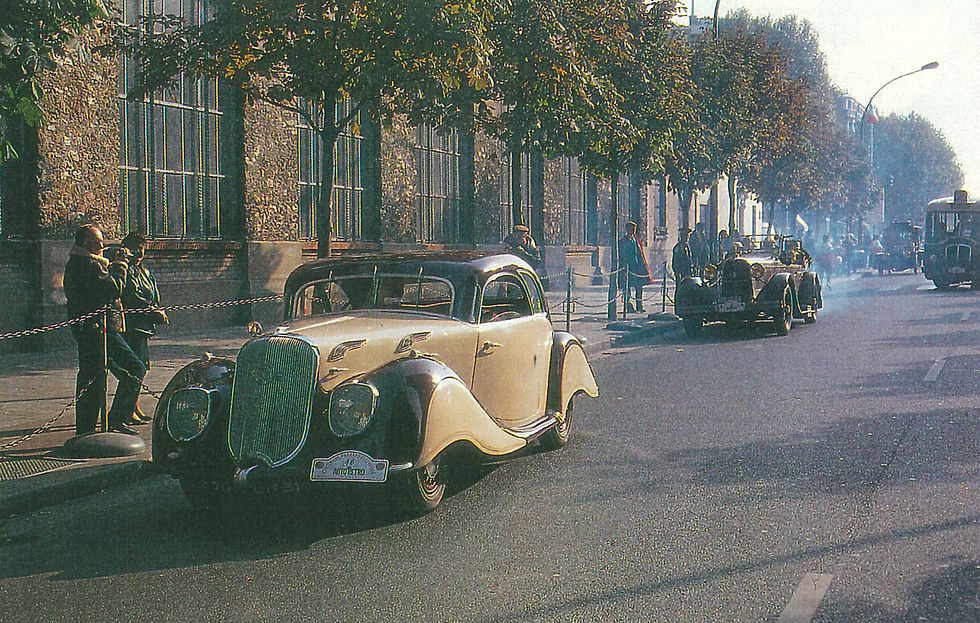
Restoring the 1938 Panhard Dynamic took time and commitment. The paint and bodywork alone took more than a year and were completed in Tarpon Springs by collector and craftsman Al Wiseman. What stands in the museum today is not just a rare French automobile, but a carefully restored example of one of the most unusual cars of the prewar era.
Why the 1938 Panhard Dynamic Stood Out

When the 1938 Panhard Dynamic was introduced it looked unlike anything else on the road. Introduced in 1936 and designed by Louis Bionier, the car brought Art Deco design into the automobile age with sweeping fenders, integrated lighting, sculpted trim and a dramatic three-piece windshield.
The triple-pane windshield grew out of Panhard’s earlier Panoramique models and improved visibility while adding to the car’s futuristic profile. The design of the 1938 Panhard Dynamic was streamlined, dramatic and highly coordinated, with repeated shapes and details that gave the whole car a unified look.

1938 Panhard Dynamic Engineering and Innovation
The engineering of the 1938 Panhard Dynamic was just as distinctive as its design. It used an electrically welded steel unibody at a time when many large luxury cars still relied on separate chassis construction. That made the 1938 Panhard Dynamic one of the more advanced production cars of its time.
Its mechanical layout included fully independent front suspension with torsion bars, engine-mounted wishbones, and four hydraulic shock absorbers. The car also featured aluminum doors, lightweight exterior brightwork, and unusual details such as push-to-shut Djinn locks, a single central sun visor and a rear-view mirror that slid along the dash rail.

The Sleeve-Valve Engine in the 1938 Panhard Dynamic
The feature that first caught Alain Cerf’s attention was the engine. The 1938 Panhard Dynamic used a 2,861 c.c. Knight sleeve-valve inline-six, one of the last sleeve-valve engines fitted to a production automobile.

Panhard had worked with the Knight system since 1910 and spent decades refining it. Instead of conventional poppet valves and springs, the engine in the 1938 Panhard Dynamic used sliding steel sleeves inside each cylinder to control intake and exhaust. The result was a smooth, quiet engine that period descriptions often called velvet-like because of its deep tone and lack of mechanical clatter.
The Unusual Driving Experience of the 1938 Panhard Dynamic

The 1938 Panhard Dynamic also used a highly unusual transmission system. Its four-speed manual gearbox worked with Panhard’s auto-débrayage et roue libre setup, combining vacuum-operated automatic declutching with a freewheel mechanism.
In practice, the 1938 Panhard Dynamic could disengage the clutch through the accelerator pedal and coast without engine braking. That made the car feel unusually advanced for the late 1930s and gave it a driving character unlike other large cars of the period.
The layout inside the 1938 Panhard Dynamic was just as unconventional. In 1938, the car still used its near-central steering position, allowing a passenger on either side of the driver. That design helped maximize cabin space and became one of the most memorable features of the car.
Louis Delagarde

The 1938 Panhard Dynamic also reflects the work of Louis Delagarde, one of the key engineers behind Panhard’s technical identity. He joined Panhard & Levassor in 1921 as a draftsman and remained there for more than fifty years, eventually becoming head of the design office.
Delagarde’s work extended far beyond the 1938 Panhard Dynamic. He improved wood-gas systems, contributed to the development of the EBR armored reconnaissance vehicle, and later helped shape the postwar Dyna Panhard. Known for practical and inventive mechanical solutions, he played an important role in Panhard’s engineering history across several decades.

See the 1938 Panhard Dynamic at the Tampa Bay Automobile Museum.
The 1938 Panhard Dynamic was advanced, unconventional and built with ideas few manufacturers would have attempted. It remains one of the museum’s clearest expressions of Art Deco design in the automobile age. See this Art Deco wonder at the Tampa Bay Automobile Museum.