
Before the Bug: Mercedes-Benz’s Rear-Engined 130H and 170H
Before the Volkswagen Beetle became one of the most recognizable cars in the world, Mercedes-Benz was already exploring the same radical idea: put the engine in the back.
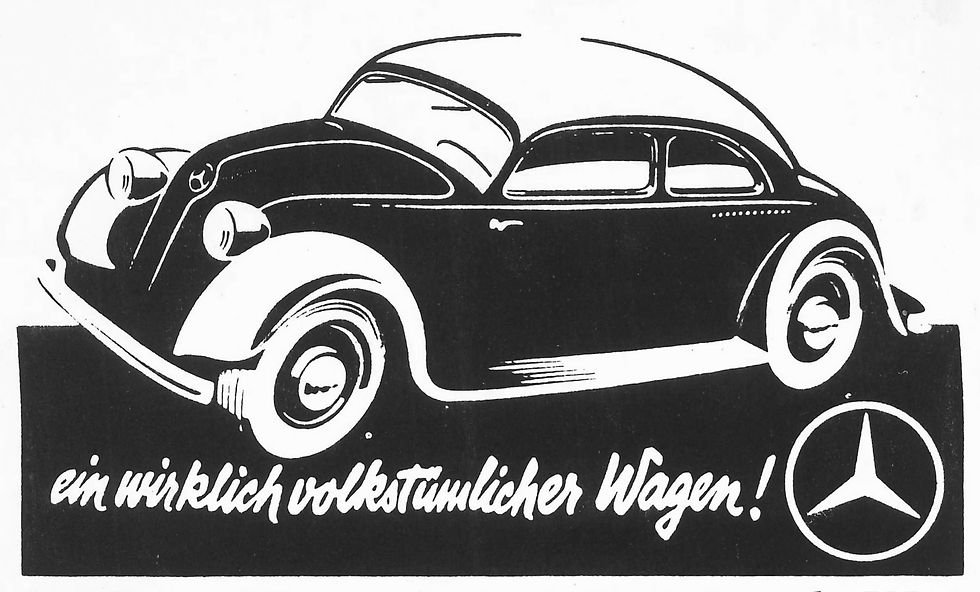
Today, that layout immediately brings the Beetle to mind. In the early 1930s, however, it was a daring departure from tradition, especially for Mercedes-Benz. This was a company known for long hoods, upright grilles, prestige engineering and commanding road presence. A small Mercedes with no conventional radiator grille and its engine tucked behind the passengers looked almost like an inside-out automobile.

The result was not one car, but a small family of experimental rear-engined Mercedes-Benz models, including the 130H and the later 170H. The “H” stood for Heckmotor, German for rear engine. These were not curiosities built in a forgotten corner of the factory. They were part of a serious engineering effort to rethink what a modern small car could be.

Why Rear Engine? The Climate of the 1930s
The early 1930s were a turning point for European automakers. Roads were improving, middle-class buyers were becoming more important and manufacturers were searching for a practical “people’s car.” The challenge was not simply to build a cheaper vehicle. It was to build a smaller one that still offered comfort, stability and genuine interior space.
That was difficult with the traditional front-engine layout. A front-mounted engine required a driveshaft running to the rear wheels, which carved a tunnel through the passenger compartment. The long hood consumed valuable length that could otherwise be used for people and luggage.
Mercedes-Benz engineers saw an opportunity. If the engine, gearbox and differential could be grouped together at the rear, the car could eliminate the conventional driveshaft, flatten the floor and create far more usable room inside a compact body.
The Engineers Behind the Idea

The rear-engined Mercedes-Benz models were closely tied to the work of Hans Nibel, the company’s chief engineer during this period. Nibel had a reputation for ambitious thinking and had already been involved in advanced chassis and suspension work. He was not simply shrinking a conventional Mercedes-Benz. He and his team were asking whether the accepted layout of the automobile had become a habit rather than a necessity.
Engineer Max Wagner was also part of this technical world at Daimler-Benz, helping shape the company’s advanced chassis thinking during the period. Together, the team explored tubular frames, independent suspension and compact drivetrains in ways that were unusual for production cars of the time.

They were also working in an era fascinated by streamlining. Designers and engineers were studying rounded forms, airflow and the teardrop shape as a way to make cars more efficient and modern. This was the age of the Streamline Moderne imagination, when speed, science and style all seemed to point in the same direction.
Mercedes-Benz was not alone. Across Europe, Ferdinand Porsche, designers at Tatra and engineers at Zündapp and NSU were also experimenting with rear-engine and streamlined small-car concepts. Something was in the air. The old automotive formula was being questioned from several directions at once.
The 130H: A Car Built Backwards on Purpose
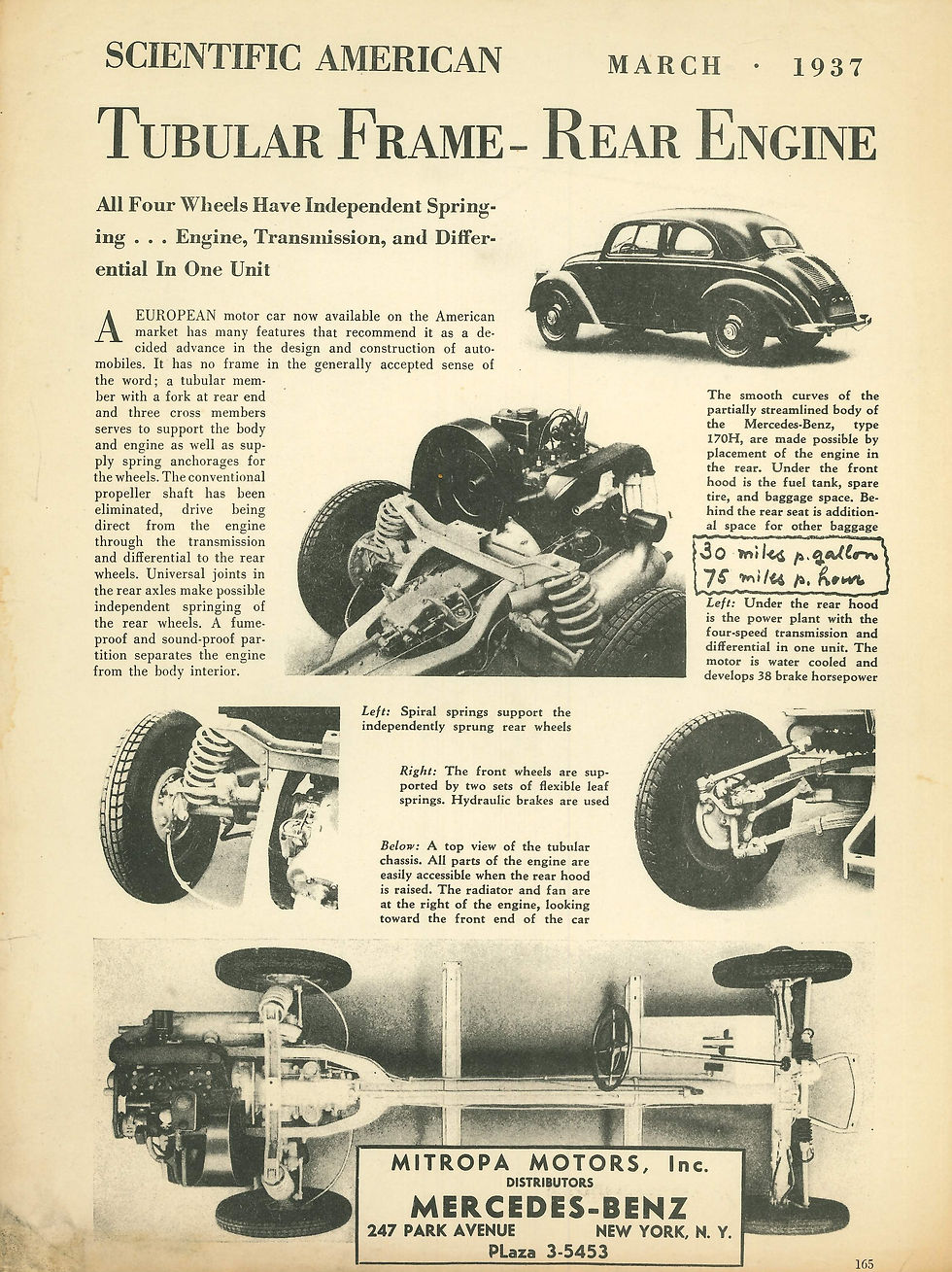
Mercedes-Benz introduced the 130H at the Berlin Auto Show in 1934. It used a rear-mounted, water-cooled 1.3-liter four-cylinder engine positioned behind the rear axle, with the gearbox and differential forming one compact unit at the back of the car.
That made the 130H dramatically different from most automobiles of the period.
There was no front engine. No long propeller shaft. No large transmission tunnel cutting through the cabin. Instead, the car used a tubular backbone frame, independent suspension on all four wheels and hydraulic brakes. The layout allowed the passenger area to be pushed forward, making the 130H feel roomier than its size suggested.
Walk around to the front and the difference becomes even clearer. Where most cars carried a large engine and radiator, the 130H used that space for luggage and the spare tire. The front hood became a kind of phantom engine bay, familiar in shape but completely reimagined in purpose.
For passengers, the promise was space. For engineers, it was efficiency. For traditional Mercedes-Benz buyers, it may have been a little too strange.
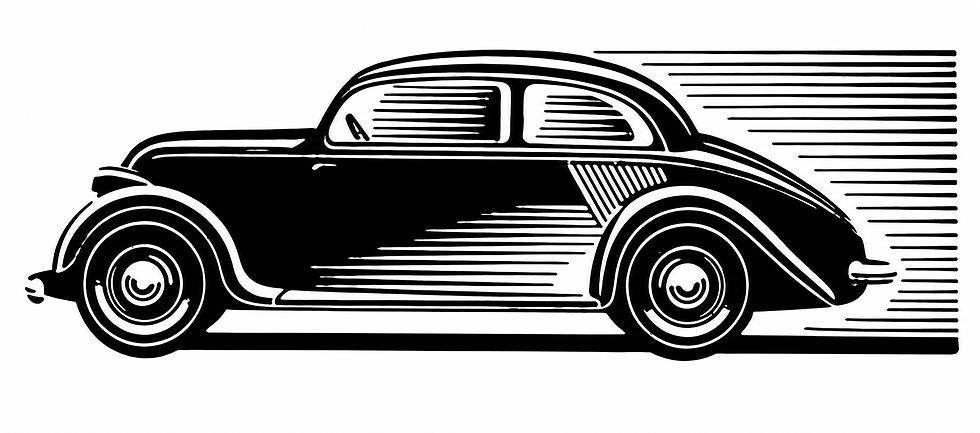
The 130H’s shape reflected its engineering. Its short nose, rounded roofline and compact proportions give it a look that feels surprisingly familiar today. It was not a Beetle, but it clearly belonged to the same era of experimentation that would eventually make rear-engine small cars famous.
One of the 130H’s most striking advantages was not space alone. It was quietness.
With the engine behind the passengers and separated from the cabin by a soundproof partition, the 130H offered a calm that most small cars of the period could not match. The Autocar road test in November 1934 put it plainly: “One is not conscious of the engine, and can scarcely hear it.”
Because the engine sat behind the rear axle, rather than between the wheels, it acted like a weight on the end of a lever. Combined with swing-axle rear suspension, this could give the car a pendulum-like feel when cornering quickly. Under harder driving, the rear could feel light, lively or unpredictable.
This was one of the great contradictions of early rear-engine design. The same layout that made the car roomy and quiet also made its handling more demanding. It rewarded careful engineering and an attentive driver, but it was less forgiving than a conventional front-engine car.
Mercedes-Benz understood both the promise and the problem. The next step was to refine the idea.
The 170H: The Idea Evolves
By 1936, the 170H had arrived. It used a larger 1.7-liter four-cylinder engine producing 38 PS, or about 37 horsepower, mounted in a more developed version of the same rear-engine layout. Compared with the grand, supercharged Mercedes-Benz models of the same era, that power figure was modest. The 170H was not meant to overwhelm with speed. Its purpose was refinement, packaging and comfort.
The 170H carried forward the advantages Mercedes-Benz had been chasing with the 130H: more interior room, reduced cabin noise and a compact drivetrain grouped at the rear.

It also improved the concept. The larger engine gave the car stronger performance, while the cooling system was carefully arranged to manage the rear-mounted engine. Warm air from the system could also be directed into the cabin during winter, turning the unusual layout into a comfort feature.
The 170H was a quieter revolution. It did not shout about speed or luxury. It offered space, calmness and mechanical cleverness in a compact Mercedes-Benz that looked forward rather than backward.
The 170H was advanced, but the market chose something more familiar.
Mercedes-Benz sold the rear-engined 170H alongside the front-engined 170V. The 170V was more conventional, less expensive and available in far more body styles. Most importantly, it looked the way buyers expected a Mercedes-Benz to look: long hood, traditional proportions and the visual prestige people associated with the brand.
Before the Bug
The Mercedes-Benz 130H and 170H belong to a fascinating crossroads in automotive history. Across Europe, engineers were rethinking the small car at the same time. Tatra was developing streamlined rear-engined designs. Porsche was working through concepts that would eventually help shape the Beetle. NSU and Zündapp explored their own compact rear-engine ideas.
The question of whether the automobile could be rearranged was being asked in design studios and engineering workshops from Stuttgart to Prague.
Mercedes-Benz asked it early, and answered boldly.
The 130H and 170H were not failed Beetles. They were proof that some of the most inventive engineers of the 1930s were chasing the same vision: a small car that felt spacious, quiet and genuinely modern.
See the Mercedes-Benz 130H and 170H at the Tampa Bay Automobile Museum, where these rare rear-engined models help tell the story of innovation before the world was ready for it.