
Gordon Buehrig: The Designer Behind the Auburn Speedster and Cord 812
There is a car in Pinellas Park, Florida that will stop you in your tracks.
It has no traditional upright radiator shell. No running boards. No chrome-capped headlights perched on the fenders. Instead, the headlights disappear into the bodywork, raised by small hand cranks on either side of the dashboard. The hood does not climb toward a radiator shell. It stretches low and forward, wrapped in horizontal louvers that looked unlike almost anything else on an American road in 1937.
The car is a Cord 812 Supercharged Custom Beverly, and it remains one of the most memorable American designs of the Classic Era.
Nearly ninety years after it was built, it still looks unusually modern for its time.
Who Was Gordon Buehrig?

Gordon M. Buehrig was one of the important American automotive designers of the Classic Era. Most people have never heard his name, but they have seen his influence. He helped shape some of the most dramatic American automobiles ever built, including the Duesenberg Model J, Auburn Speedster and Cord 810/812.
His best designs did not simply decorate machinery. They showed how engineering could influence the shape of a car.
In 1924, he began working at the Gotfredson Body Company in Wayne, Michigan, which was then building bodies for Wills Sainte Claire, Peerless and Jewett. Buehrig later described body surface development as an old craft related to boat-hull lofting and aircraft work, but still directly descended from carriage construction.
Bodies were built with wooden frames and metal skins. Every joint, screw, panel break and molding mattered. A design had to become a full-size body draft, then a wooden structure, then a finished body.
That background mattered. Buehrig learned that a body was not just a drawing. It was a structure, a surface and a set of buildable decisions.
That training shaped him for the rest of his career. Many stylists could draw a beautiful side profile. Buehrig understood what happened after the drawing left the desk. He knew how a surface became a body, how a seam could be hidden and how a beautiful line had to survive the shop floor.

Before he became famous, Buehrig moved through Dietrich, Packard, Stutz and General Motors’ Art and Colour Section. At GM, he encountered full-size clay modeling, which allowed designers to judge a car as a three-dimensional form rather than a flat drawing.
He also became chief body designer at Duesenberg, where he helped shape the legendary Model J. That experience placed him at the center of America’s grandest luxury-car world before he returned to Auburn, Cord and Duesenberg during the difficult years of the Depression.
At Duesenberg, Buehrig also learned why individuality mattered in the luxury-car market. He later explained that many custom body companies had recognizable construction habits, from hardware to roof sweeps and body contours. A Duesenberg body built by the same firm that supplied Lincoln or Pierce-Arrow could risk looking too familiar. Because Buehrig could create body drafts, not just presentation sketches, he could help give Duesenberg bodies a more distinct surface and character.
A Design That Divided Opinion
In the early 1930s, Buehrig entered an internal design contest with a streamlined concept. It had a sealed engine compartment, unconventional radiator placement and a shape that did not resemble the tall luxury cars around it. The official judges placed it last. But when the designers themselves voted, they placed it first. The difference in opinion is revealing. Some saw a design that was too unfamiliar. Other designers saw ideas that were worth taking seriously.

That instinct soon brought Buehrig back into the world of Auburn, Cord and Duesenberg, where salesmanship, engineering and survival were closely connected. Harold T. Ames, president of Auburn Automobile Company, wanted cars that could attract attention in a difficult market. That challenge suited Buehrig well.
Auburn Speedster: A New Face for a Difficult Market

When the earlier “baby Duesenberg” project temporarily paused, Ames reassigned Buehrig to lead a fast redesign of the poorly received 1934 Auburn lineup.
Meeting at a cottage on Lake Wawasee over the Fourth of July holiday, Buehrig and Ames determined the look of the new 1935 line. They straightened the beltline, redesigned the front fender dies and introduced a more refined radiator design.
Auburn needed attention, and Ames wanted something memorable for the auto show. Buehrig helped transform existing speedster material into the dramatic 1935 Auburn 851 Speedster. The nearly identical 1936 version would be known as the Auburn 852 Speedster.

The Speedster was a clever reuse of existing material, not a clean-sheet design. Buehrig later recalled that Auburn had leftover 1933 Speedster bodies at Union City Body Company. His team adapted the center section to the new 1935 Auburn frame, placed the new radiator and grille, shaped the fenders in clay and created a new rear section influenced by earlier Duesenberg boattail speedster work.

The result was low, long and deliberately theatrical, but its drama came from practical decisions made under pressure. Supercharged Auburn Speedsters carried plaques certifying performance over 100 mph, turning speed itself into part of the sales story. In a difficult Depression-era market, Auburn sold glamour, power and escape.
The exposed pipes were not only decorative. Buehrig later noted that the outside exhaust treatment on supercharged Duesenbergs had a practical origin: moving heat out from under the hood. Auburn borrowed that visual language for the supercharged Speedster, where it became part of the car’s identity.
Buehrig gave that promise a shape buyers could understand.
Cord 810 and Cord 812: Front-Wheel Drive Shapes the Design

The Cord 810 and Cord 812 became Buehrig’s most advanced production designs.

The project that became the Cord 810 began as a smaller, less expensive companion to the mighty Duesenberg Model J. Often described as the “baby Duesenberg,” it was too developed to abandon when plans changed. E.L. Cord saw that the design could revive the dormant Cord name, and the project evolved toward a new front-wheel-drive automobile.
Front-wheel drive changed the proportions of the car. Because there was no long driveshaft running to the rear axle, the body could sit lower. Without a large driveshaft tunnel, the passenger compartment could be cleaner and lower. The car no longer needed running boards or the upright stance of many older luxury automobiles.
Buehrig did not hide the engineering under traditional styling. He allowed the layout of the car to influence the shape.
To achieve the Cord’s clean surfaces, Buehrig’s team used a movable “styling bridge,” an inverted U-shaped measuring tool that traveled over the clay model on tracks. It helped designers locate points on the three-dimensional surface and translate them back into body drafts, making the shape buildable rather than merely attractive.

The Cord 810 at the New York Auto Show
When the Cord 810 debuted at the New York Auto Show in November 1935 as a 1936 model, it drew heavy crowds. Reports from the show describe people climbing onto nearby cars to get a better look.

Most American luxury cars of the 1930s still carried tall radiator shells, separate headlights, upright bodies and running boards. The Cord removed many of those familiar elements.
Instead of an upright radiator shell, Buehrig gave the Cord a low, clean front end with wraparound hood louvers and the famous “coffin nose.” Instead of exposed headlamps, the lights were fully recessed into the front fenders and mechanically raised by individual hand cranks on the outer edges of the dashboard. Even the hidden headlamps evolved during development. One early Cord 810 prototype used lights that folded into the inner sides of the fenders before the production design settled on the familiar crank-operated concealed headlamps.
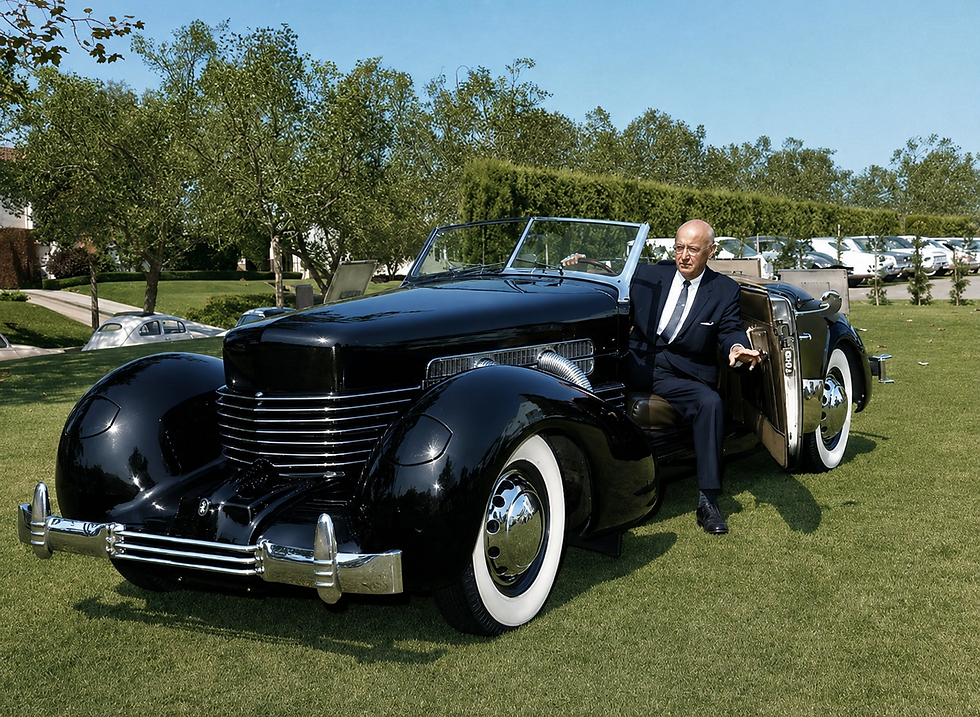
The 1936 car was called the Cord 810. For 1937, it became the Cord 812. The basic design carried forward, but the model number changed, which is why the cars are often discussed together as the Cord 810/812.
Supercharging became one of the Cord’s most recognizable visual features.
Supercharged 1936 models were called 810S, while supercharged 1937 models were called 812S. These cars used a Schwitzer-Cummins supercharger and were distinguished by external chrome exhaust pipes sweeping from the side hood panels. The performance equipment was not hidden. It became part of the car’s appearance.
The Cord looked different because its layout, proportions and details were different.
1937 Cord 812 Supercharged Custom Beverly at Tampa Bay Automobile Museum
The Tampa Bay Automobile Museum’s 1937 Cord 812 Supercharged Custom Beverly is a strong example of Gordon Buehrig’s production design.

The Custom Beverly was not merely a closed sedan version of the Cord. It was part of the 1937 Custom series, built on a longer 132-inch wheelbase, compared with the standard 125-inch wheelbase. Bob White’s article on the car notes that only 141 supercharged Custom Beverlys were made, making this sedan a rare example of Buehrig’s design language in formal luxury form.

Inside the Cord, the sense of innovation continued with a machine-age cockpit. Instead of a traditional floor shifter, the car used a Bendix vacuum-electric preselector system advertised as a “Finger Touch Gear Shift.”
A small selector mounted on the steering column below the steering wheel allowed the driver to choose the desired gear in a miniature shift pattern. The actual gear change occurred when the driver depressed the clutch pedal, completing the electrical circuit and allowing the vacuum-assisted mechanism to move the transmission.
Gordon Buehrig After Auburn, Cord and Duesenberg


The Auburn-Cord-Duesenberg empire did not survive the economic pressures of the 1930s, and Buehrig left the company in 1936. His career, however, continued across several important chapters.
He later worked with the Edward G. Budd Manufacturing Company on prototype designs, contributed to wartime aircraft-related work and spent a brief period under Raymond Loewy at Studebaker.
In 1948, he designed the aircraft-inspired TASCO sports car. Though it never reached production, it featured removable roof panels, an idea Buehrig later patented and one that anticipated the T-top layout later associated with cars such as the Corvette.
In 1949, Buehrig joined Ford Motor Company, where he remained until 1965. His work included body development, station wagon programs, Continental Mark II engineering, retractable hardtop ideas and research into automotive plastics. After retiring from Ford, he taught industrial design at the Art Center School in Los Angeles.
See the Cord 812 in Pinellas Park, Florida

See the 1937 Cord 812 Supercharged Custom Beverly at the Tampa Bay Automobile Museum in Pinellas Park, Florida. Explore its hidden headlights, supercharged engine, front-wheel-drive layout and distinctive Buehrig design alongside a collection dedicated to the advanced automotive ideas that shaped the future.