
Jean Édouard Andreau: Inventor of Modern Car Aerodynamics
Updated: Mar 4

Before wind tunnels were standard, Jean Édouard Andreau (1890–1953) shaped cars to cut air, save fuel, and win speed.
Andreau was born on November 17, 1890, in Pontacq, a small town near the French Pyrénées. He trained as a military engineer at École spéciale militaire de Saint-Cyr and graduated in 1913.
Born on November 17, 1890, in Pontacq near the French Pyrenees, Andreau trained as a military engineer at École spéciale militaire de Saint-Cyr, graduating in 1913. When World War I began the next year, he went to the front as an infantry officer, was seriously wounded in 1914, and declared unfit for combat. The army reassigned him to technical services, where he learned to measure drag and shape objects to reduce it, a lesson he later applied directly to cars.
The efficiency obsession begins
After the war, Andreau pivoted from weapons to engines. In 1924, he built a variable-stroke engine noted for fuel-efficiency performance at the Conservatoire National des Arts et Métiers. Accounts describe it being produced in meaningful numbers.
By the early 1930s, Andreau was pushing three ideas that would become central to modern car design.
1) The body as structure (unibody / monocoque)
Andreau explored lightweight “shell-as-structure” thinking in his prewar work, and later applied it dramatically in the VL333.
2) Scientific aerodynamics for cars
He helped push early wind-tunnel work on car shapes into serious engineering territory, measuring drag instead of arguing over style.
3) Drag + weight as one system
He understood something the industry took a long time to operationalize: drag reduction and weight reduction multiply each other. Less drag means less power needed. Less weight means less power needed. Less power means a smaller engine. A smaller engine means less weight. It becomes a virtuous circle, but only if you design for it from the beginning instead of treating performance and efficiency as opposing forces.

The Dubonnet Dolphin
In 1935, Andreau partnered with André Dubonnet, the wealthy French aviator, racing driver, and inventor who had made a fortune licensing his independent suspension designs to General Motors and Fiat. Together they built the Dubonnet Dolphin, a radical streamlined car with a rear-mounted Ford V8 engine and a body shaped entirely to Andreau's aerodynamic specifications. In a demonstration at the Autodrome de Linas-Montlhéry observed by the Automobile Club de France, contemporary accounts reported the results as dramatic: roughly 35 percent higher top speed and approximately 25 percent lower fuel consumption than a comparable Ford of similar weight and power.
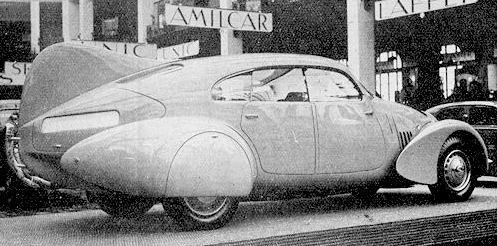
1936 Peugeot 402
The Peugeot 402 Andreau, shown at the 1936 Paris Motor Show, is perhaps the most revealing of all his work. Here was a mainstream manufacturer willing to let an aerodynamicist completely rewrite the silhouette of a production platform. Peugeot's own promotional materials at the show credited Andreau's body with giving the car its aerodynamic profile and road behavior. Five examples were built. Peugeot was seriously considering putting the design into full production before the war made the decision for them. It is a tantalizing glimpse of what French roads might have looked like if history had been kinder.

1937 Thunderbolt
The Thunderbolt, built for Captain George Eyston's land speed record attempts, tells a very different story. When the goal is not efficiency but raw velocity, the aerodynamic stakes become existential. A poorly shaped body at 300 miles per hour is not just wasteful, it is dangerous. Eyston trusted Andreau to shape the car that would go faster than anything on earth had ever gone, and the Thunderbolt delivered, setting the world land speed record multiple times. Even at the absolute extreme of speed, Andreau's obsession stayed exactly the same: stop wasting energy fighting air you could be cutting through.

1938 Hispano-Suiza Dubonnet Xenia
The 1938 Hispano-Suiza Dubonnet Xenia is the glamorous proof that aerodynamics and beauty are not opposites. Working again with André Dubonnet and the celebrated coachbuilder Jacques Saoutchik, Andreau helped create one of the most visually astonishing automobiles ever built. The Xenia demonstrates something Andreau understood that many of his contemporaries did not: a shape optimized for airflow does not have to look like a calculation, it can look like a dream.

1946 Mathis VL333
Andreau approached the Mathis organization with a proposal. He had been refining his teardrop three-wheeler concept since 1934 and never stopped developing it. The car he was proposing was the most complete expression of everything he had spent his career working toward: a frameless aluminum body carrying its own structural loads, a shape that pushed drag into territory few road cars had reached even on paper, three wheels instead of four to eliminate an entire axle and its weight, and a small engine that could do the work of a much larger one because the body cooperated with physics instead of fighting it.

The work proceeded with the Mathis engineering team in France while Émile Mathis ran his munitions operation in New York. Development was conducted in secret because building civilian cars under occupation was forbidden, and the engineers involved were breaking the law of the occupying power. Nine prototypes were completed between 1942 and 1945. Because testing on French roads risked discovery, the cars were quietly driven across the border into Switzerland, road tested there, and smuggled back into France.
The car was called the VL333: “VL” for Voiture Légère (Light Vehicle), and “333” for three wheels, three seats, and three liters of fuel per 100 kilometers. The name doubled as a manifesto.
The body achieved a drag coefficient of 0.22, which Andreau believed could be reduced further with a slightly longer tail. For context, Toyota has cited a Cd of 0.28 for the Camry. In official French government testing in September 1942, the VL333 reached 65 mph and returned 69 mpg on a 707cc engine smaller than most motorcycles.
After the liberation, the VL333 finally appeared publicly at the Paris Automobile Salon. Crowds gathered. The press wrote about it as a vision of what motoring could become.

Enfield-Andreau Wind Turbind
In the early 1950s Andreau turned his lifelong study of airflow toward a new problem: wind energy. He developed a turbine with hollow blades that used centrifugal force to draw air through the rotor tips and power a generator housed in the tower base, reducing the mechanical load at height. The design was built and tested in England as the Enfield-Andreau turbine, with a 100-kilowatt machine documented at St Albans in 1953 in a NASA wind-energy report.

See the VL333 today
The only surviving Mathis VL333, the car Jean Édouard Andreau designed in secret during the German occupation of France, smuggled across borders for testing, and unveiled at the 1946 Paris Automobile Salon, is on permanent display at the Tampa Bay Automobile Museum in Pinellas Park, Florida.