
NSU Wankel Spider | First Rotary-Powered Sports Car
Updated: Dec 16, 2025
In the mid-1960s, when most sports cars still relied on small piston engines and familiar technology, NSU decided to bet on something entirely new. The result was the NSU Wankel Spider, a compact two-seat convertible that quietly rewrote history as the first Western production car powered by a Wankel rotary engine.

Built in Neckarsulm, West Germany between 1963 and 1967, the Spider was produced in very small numbers. Only 2,375 cars left the factory, which already makes this innovative little machine a rare sight today.
A Bertone Body with a Radical Heart
At first glance, the Spider appears to be a tidy, cheerful European roadster of its era. Its body, crafted by the Italian design house Bertone, borrowed the structure of the earlier NSU Sport Prinz coupe but transformed it into a breezy cabriolet with a folding soft top and a distinctive grille.
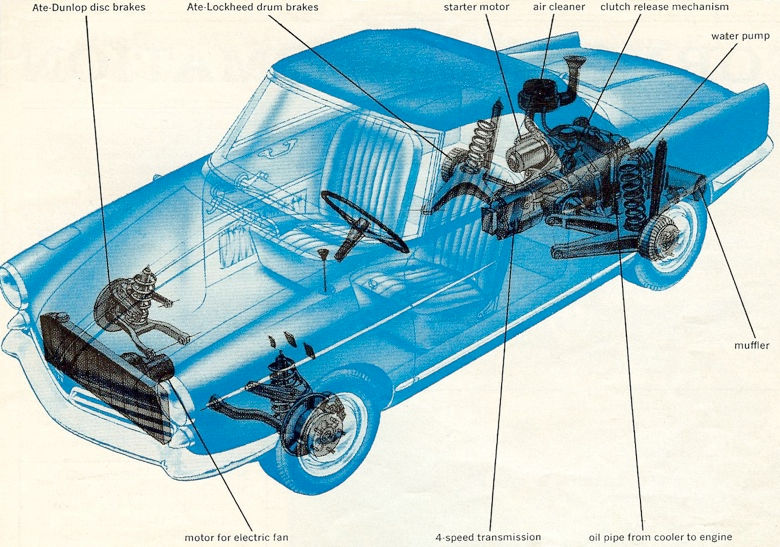
What truly set it apart was its engine. Nestled over the rear axle was a single-rotor Wankel rotary, a compact 500 cc powerhouse driving the rear wheels through a four-speed, all-synchromesh manual transmission.
Because the rotary was so small, NSU placed the radiator and fuel tank up front. This unusual layout provided a luggage compartment in the nose and a second storage space above the engine in the rear.

How the Rotary Engine Worked
The Wankel rotary engine was unlike anything on the road at the time. Instead of pistons pumping up and down, a triangular rotor spun inside an oval housing, creating combustion chambers that expanded and contracted as it rotated. The result was a compact, eager little engine with smoothness, high rev potential, and an impressive power-to-weight ratio.
In the Spider, the engine displaced 498 cc and produced 50–54 hp, depending on model year. Top speed hovered around 95–100 mph, with 0–60 mph arriving in roughly 14–15 seconds. Respectable numbers for a feathery light 1960s roadster.
The engine was water-cooled, its rotor oil-cooled, and it breathed through a Solex carburetor. NSU also fitted front disc brakes as standard, still an advanced feature for small sports cars of that era.

Driving Character: Smooth, Light, and Unusual
Period road tests describe the Spider as a car full of contrasts. Its chassis behaves like other small European sports cars of the time: light, nimble, and simple. The rotary engine, though, changes the entire experience. It revs with almost no vibration and sings a soft whirring hum rather than the familiar four-cylinder growl.
The unusual placement of the engine at the rear and the radiator at the front gives the Spider surprisingly balanced weight distribution. Paired with its low curb weight of about 700 kg and standard front discs, the car feels agile and eager on winding roads.

In the United States, driver Al Auger campaigned a Spider in SCCA road races in 1966 and 1967, becoming the first person to race a Wankel-powered production car in sanctioned competition.

A Small Car with Big Legacy
Standing beside an NSU Wankel Spider feels like encountering the ancestor of every rotary legend that followed. It is small, bright, and inviting, yet it carries one of the boldest engineering ideas of the 20th century in its rear engine bay.
See it during the Rotary Exhibit at the Tampa Bay Automobile Museum from January 10, 2026 and running until April 30, 2026.