
Robert Hannoyer’s Reyonnah: The French Microcar That Folded Itself to Park
In postwar France, Robert Hannoyer wanted to solve a problem that still frustrates drivers today: how do you park a car when city space is limited?

Hannoyer was a garage mechanic in Paris, the kind of inventor who understood machines through grease, repair work and real-world problems. In the late 1940s, Paris was crowded, fuel was scarce, materials were limited and public parking space was difficult to find. Small, economical vehicles were not just curiosities. They were practical answers to everyday life.
His solution was the Reyonnah, a tiny two-seat French microcar with front wheels that could fold inward beneath the body. At full width, the car measured about 1.45 meters across. When folded, it narrowed to about 0.75 meters, making it slim enough to pass through narrow entrances, courtyard gates or even the doorway of a house.
The name Reyonnah, came from Hannoyer’s own surname, spelled backward.
A Car That Could Fold
The Reyonnah’s magic was hidden in its front suspension.
Each front wheel was mounted on a special folding mechanism using parallelogram arms. Flexible hydraulic brake hoses allowed the braking system to stay connected as the wheels moved. Hannoyer had thought beyond the trick itself. He designed the car so the important mechanical systems could keep working even as the vehicle changed shape.

Because the Reyonnah was so light, the front end could be lifted by hand. Once raised, the front wheels tucked inward beneath the body. In its folded position, the little car could be rolled into spaces ordinary cars could never reach.
The Tampa Bay Automobile Museum’s Reyonnah uses a small AMC engine, a compact French single-cylinder powerplant well suited to postwar microcars. It was simple, economical and practical, exactly the kind of machinery Hannoyer needed for a lightweight city car. The uploaded AMC manual supports this engine context, covering 125 cc and 175 cc four-stroke AMC engine blocks.
From Paris Salon to Public Sensation
The Reyonnah made its public debut at the 1950 Paris Salon.
The first prototype had a sleek body, enclosed rear wheels, helmet-style front fenders, unusual slotted wheels and a folding chrome-plated windshield.
Later Reyonnahs had a straighter body line, simpler front fenders, a fixed windshield and a side-hinged canopy. Some could be fitted with a folding canvas top, while others had a taller hardtop with side windows and a sunroof.
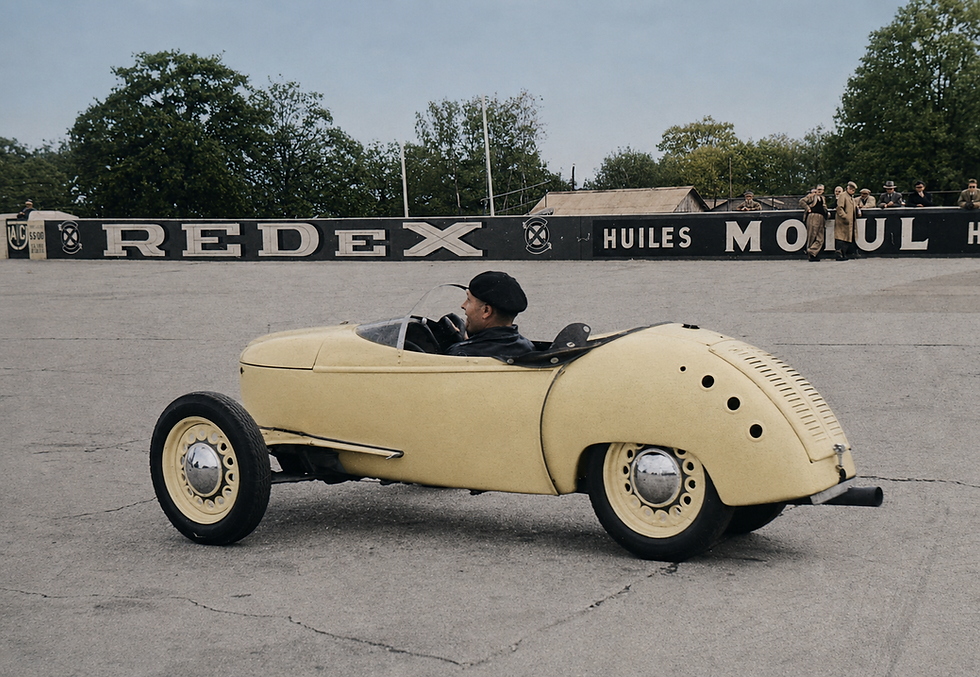
Hannoyer displayed the Reyonnah at Paris shows, demonstrated it at Automobile Club de France events, entered it in concours d’élégance competitions and tested it at Montlhéry. A special Torpedo-Sports version reportedly reached 100 km/h, an impressive figure for such a small machine.

The Reyonnah attracted attention everywhere it went. Actress Paulette Dubost helped bring it into the spotlight by appearing with the car at elegant public events. Vintage interviews describe crowds gathering around it in Paris, fascinated by the tiny car that could fold itself narrow enough to disappear into spaces other cars could never use.
See the Car at the Tampa Bay Automobile Museum
Hannoyer was a skilled mechanic and inventor, but building a few hand-crafted prototypes was very different from manufacturing cars at scale. Without the investment needed to move into full production, only 16 were made.
That rarity is part of what makes the Tampa Bay Automobile Museum’s 1951 Reyonnah Prototype N°1 so special today. It is not just an unusual microcar. It is a surviving piece of postwar imagination, designed for a world short on fuel, short on space and hungry for new ideas.