
Mercedes-Benz C 111: The Mysterious Supercar That Never Was
- Jan 12
- 4 min read
By the late 1960s, engineers were openly questioning whether the piston engine had reached the end of its evolution. Among the most radical alternatives was the rotary engine, a compact and remarkably smooth design that promised high performance with fewer moving parts. While today the rotary is most closely associated with Mazda, some of the most serious early research took place in Germany, inside an experimental vehicle built by Mercedes-Benz. That vehicle was the Mercedes-Benz C111, a car never intended for production, but created solely to explore what the future of automotive engineering might look like.
A Supercar That Began as a Specification Sheet
Unlike most concept cars, the C111 did not begin with styling sketches or consumer expectations. It began with engineering constraints.

Mercedes engineers defined the project around strict parameters: a height of approximately 1.10 meters, a 2.62-meter wheelbase, staggered front and rear track widths, and a mid-mounted rotary engine intended for sustained high-speed operation approaching 260 km/h, not brief peak-speed demonstrations.
The engine bay was intentionally designed with excess space and modular mounting, allowing engineers to test multiple powertrains over time. This decision enabled the same basic chassis to host three-rotor, four-rotor, V8, and later diesel engines without fundamental redesign.

The body was constructed from glass-fiber-reinforced plastic, selected for weight savings and ease of modification rather than appearance. Body panels could be replaced or altered quickly as testing evolved. While this led to visible fit-and-finish inconsistencies, beneath the skin was a welded and riveted steel floor structure with an integrated roll bar, reflecting the seriousness of the car’s engineering purpose.
The Rotary Engine

The rotary engine, developed by Felix Wankel, replaces pistons, connecting rods, and crankshafts with a triangular rotor spinning inside a trochoid-shaped housing. Intake, compression, combustion, and exhaust occur continuously in different regions of the housing.
Its theoretical advantages were clear:
High power-to-weight ratio
Exceptionally smooth operation
Compact packaging
Fewer major moving components
Mercedes engineers considered these advantages significant enough to justify full-scale, sustained testing rather than limited demonstrations.
Three Rotors, Then Four

The first rotary-powered C111 used a three-rotor engine, with each chamber displacing 600 cubic centimeters. Internally, Mercedes engineers compared this configuration to a 3.6-liter piston engine in terms of airflow and combustion demand, a comparison that challenged conventional displacement metrics.

Power output ranged from approximately 258 to 280 horsepower, with top speeds near 260 km/h. Torque delivery, however, was relatively modest, highlighting a fundamental characteristic of rotary engines: high specific output paired with less low-speed torque than equivalent piston engines.
Rather than abandon the concept, Mercedes expanded it.

By 1970, engineers introduced a four-rotor configuration, increasing output to roughly 350 horsepower and pushing projected top speeds toward 300 km/h. According to internal documentation summarized in the definitive history, by this stage mechanical development had reached a high level of refinement. Cooling, lubrication, and sealing systems had been significantly improved.
What Mercedes Learned That Few Others Documented So Clearly
The C111 program produced conclusions that still surprise enthusiasts:
Sealing issues were not eliminated, but they were increasingly manageable through material and lubrication advances.
Thermal efficiency remained the core limitation, driven by the rotary engine’s elongated combustion chamber geometry.
Fuel consumption and exhaust emissions were inherent challenges, particularly as regulatory standards tightened in the early 1970s.
One four-rotor test configuration employed modified intake geometry that
reduced peak output but produced unusually consistent torque across a broad rev range. Period engineers described the engine as remarkably elastic, capable of smooth acceleration from low engine speeds without hesitation, a trait that reinforced the rotary’s reputation for refinement.
From Rotary Test Bed to Record Platform
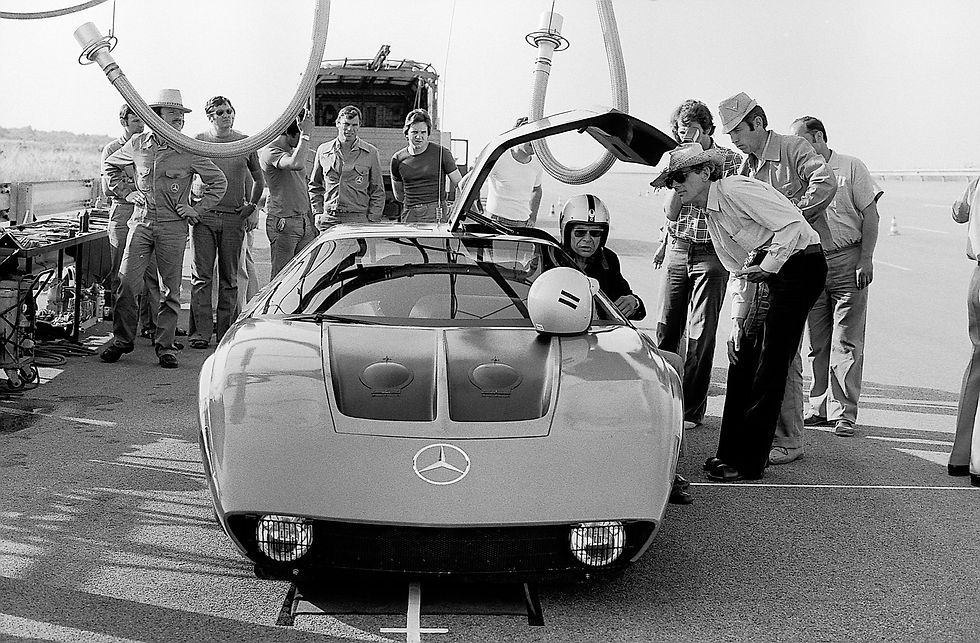
As global emissions standards advanced and the 1973 oil crisis reshaped automotive priorities, Mercedes formally ended rotary development. The C111, however, remained an invaluable research tool.
Externally little changed, the platform was repurposed with turbocharged five-cylinder diesel engines, becoming the C111-IID. Between 1976 and 1979, these cars set multiple world speed and endurance records at the Nardò test track in Italy, including sustained high-speed runs exceeding 158 mph.
The same experimental chassis that once explored rotary combustion now helped redefine diesel performance.
From Rotary to Electric: The Vision One-Eleven
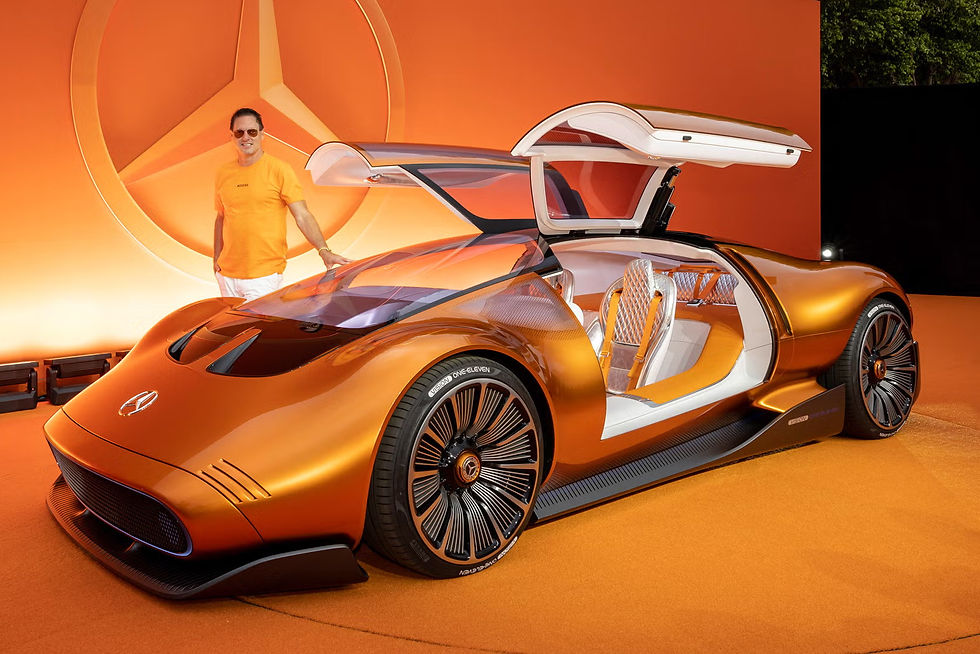
More than fifty years after the original C111 prototypes explored rotary and diesel power, Mercedes revisited the idea of an experimental supercar with the Mercedes-Benz Vision One-Eleven. Unveiled in 2023, the Vision One-Eleven is not a continuation of the C111 program but a deliberate homage to its role as a rolling technology laboratory. Instead of Wankel rotors, it showcases compact axial-flux electric motors, developed by YASA, which Mercedes describes as significantly lighter and smaller than conventional EV motors. As with the original C111, the concept is less about production intent than about exploring packaging, efficiency, and performance limits.
Explore Rotary Engine History at the Tampa Bay Automobile Museum

The story of the Mercedes-Benz C111 is inseparable from the broader history of rotary engine technology, one of the most ambitious alternatives ever proposed to the piston engine.
To see how rotary engines work, why they fascinated engineers, and how different manufacturers reached different conclusions, visit the Tampa Bay Automobile Museum during its Rotary Engine exhibit.