
The 1922 Milburn Light Electric
Updated: Aug 4
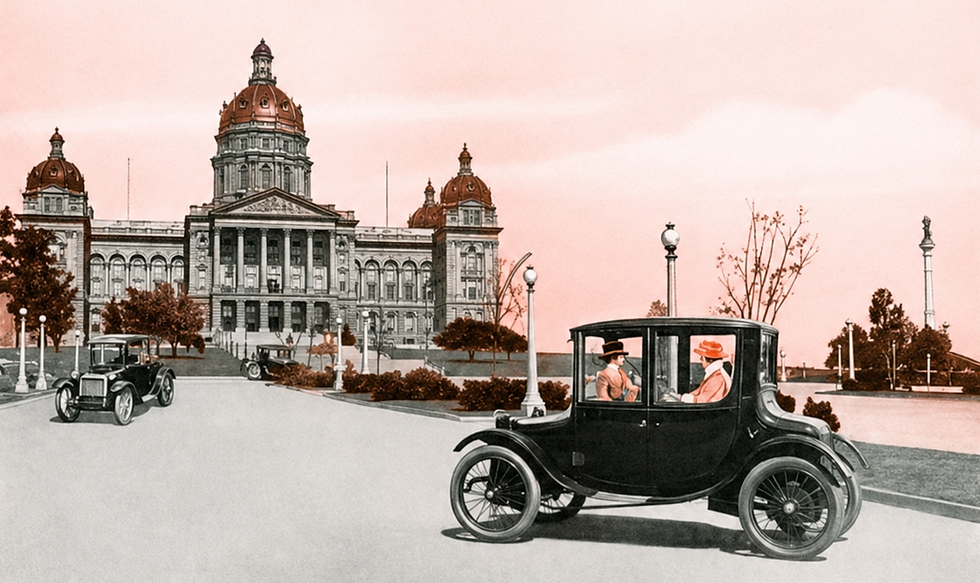
In the early 1900s, city streets were shared by steam cars, gasoline automobiles, electric vehicles and horse-drawn wagons. Gasoline cars were becoming faster and more affordable, but they could also be noisy, dirty and difficult to operate.
For many urban motorists, electric automobiles offered a quieter, cleaner and simpler alternative. Owners with suitable charging equipment could recharge at home, while some cities supported public charging stations and commercial garages equipped to service electric cars.

The 1922 Milburn Light Electric at the Tampa Bay Automobile Museum survives from the closing years of America’s first electric-car age. By then, gasoline had captured most of the automobile market, but cars like the Milburn still offered city drivers something compelling: quiet operation, simple controls and freedom from the noise, fumes and mechanical complexity of a gasoline engine.

From Wagon Works to Automobile Body Builder
The Milburn story began decades before the company produced its own electric automobile.
George Milburn entered the wagon business in Mishawaka, Indiana, during the middle of the nineteenth century. The Milburn Wagon Company moved to Toledo, Ohio, in the 1870s, where it constructed a large steam-powered factory on Monroe Street.
The new plant was highly advanced when it opened. A 250-horsepower steam engine drove machinery through an extensive network of line shafts, pulleys, gears and belts. The company became one of the country’s most successful farm-wagon manufacturers.

Storm damage, fires and repeated rebuilding gradually diluted the Milburn family’s ownership. Toledo businessman Frank Dunlevy Suydam invested in the company, became its secretary in 1876 and served as president from 1894 until his death in 1911.
By the time electric automobiles entered production, the Milburn family was no longer directing the company. The machinery that had made the Toledo plant remarkable in the 1870s was also no longer state of the art. Milburn’s importance to automobile manufacturing came instead from its later expertise in designing and producing bodies efficiently.

Milburn became a contract body builder for automobile companies including Ford, Pope-Toledo, Willys-Overland and Oldsmobile. Body production remained the company’s principal business throughout the electric-car period, while Milburn Electric production occupied a smaller portion of the operation. Contemporary reports indicate that around 200 to 250 employees worked on the electric cars, while a much larger workforce produced bodies for other manufacturers.
Ohio Electric Comes to Milburn

The first electric automobile assembled at the Milburn factory was not a Milburn. It was the Ohio Electric.
Henry Perkins Dodge, an electrical engineer and former University of Michigan classmate of Horace Suydam, helped establish the Ohio Electric Car Company with his brother Frederick and several Toledo investors. Beginning in 1909, Milburn built the bodies and provided space for the cars to be assembled using motors, running gear and other components supplied by outside manufacturers.
The two companies considered merging, but their leaders had different ideas about the future of electric transportation.
Ohio Electric concentrated on sophisticated luxury automobiles for wealthy customers. After Frank Suydam died in 1911, his son Horace became president of Milburn. Horace also held an electrical engineering degree and favored a simpler, lighter and more affordable electric car that could benefit from Milburn’s efficient body-production methods.
Ohio Electric moved to its own factory a few blocks away on Bancroft Street. Milburn then began preparing an electric automobile under its own name.
Creating the Milburn Light Electric

Milburn assembled a team to develop its new car in 1914. Karl K. Probst designed the vehicle’s platform and mechanical layout, while body engineer George H. Woodfield designed its coachwork. Woodfield also helped establish the tooling and production methods that made Milburn successful in enclosed automobile bodies.
He is credited with inventing the Dura mechanical window lift, produced by a Milburn-associated company and used throughout the Milburn automobile line. The system allowed the door, front and rear windows to be raised and lowered mechanically, an important comfort feature in a fully enclosed car.

Milburn’s strength was not making every component itself. The electric-car department operated largely as an assembly and coachbuilding operation. General Electric supplied the motor and controller, Philadelphia supplied the lead-acid batteries and specialist vendors produced much of the running gear.
A contemporary 1914 trade report said Milburn had spent approximately two years building and testing experimental cars before announcing the production model. The finished automobile, however, was based largely on established electric-car technology rather than a radically new type of chassis

The Milburn Light Electric was announced in September 1914 and entered production as a 1915 model. The original lineup included a coupe for $1,485, a roadster for $1,285 and a delivery chassis for $985.
Milburn promoted the cars as lighter and less expensive than most competing electrics. The original coupe weighed approximately 2,000 pounds, used a General Electric motor and carried a Philadelphia lead-acid battery. Its advertised range was 60 to 75 miles, with a maximum speed of approximately 20 miles per hour.

The Light Electric was still expensive compared with a mass-produced gasoline car, but it became one of the more affordable enclosed electric automobiles available.
The Evolution of the Model 27
Milburn continued refining the car after the first models entered production.

The Model 27 Brougham appeared for 1917 with a lower body on a 105-inch wheelbase. Its rear seat accommodated two passengers, while two forward-facing auxiliary seats folded completely out of sight when they were not needed.

This created a remarkably flexible interior. With the seats folded away, the passenger compartment could carry packages, luggage or even a small trunk.

Woodfield’s body design also featured wide doors, movable front and rear windows and sashless door windows operated by Dura mechanical window lifts. Smooth steel body panels concealed much of the car’s structure, helping give it a cleaner and more modern appearance than earlier carriage-shaped electrics.
The Model 27L represented a later development of this design. By 1922, the Milburn had evolved into a mature urban automobile that combined practical seating and carefully designed coachwork with proven mechanical and electrical components.
How the Milburn Worked
The 1922 Model 27L used a General Electric direct-current motor to power the rear wheels through a Timken worm-gear drive. Its heavy lead-acid batteries were divided between compartments at the front and rear, helping distribute their considerable weight across the chassis.
The driver steered with a tiller-style handle instead of a conventional steering wheel. A separate controller handle moved the electrical system through its forward power settings, while a pedal selected reverse.
The factory instructions also identified the main switch, service brake, emergency brake, horn button, headlamps, dimmers and interior lights. The Model 27L combined electrical braking through the motor with mechanical brakes acting on the rear wheels.

A period brochure lists a 105-inch wheelbase, wire wheels, semi-elliptic front springs and cantilever rear springs.
Compared with many gasoline automobiles of the period, the Milburn was simple to operate. There was no clutch to coordinate, no conventional gearshift and no gasoline engine to crank by hand. The driver switched on the electrical system, selected a controller position and moved away without engine noise or tailpipe exhaust.
Charging an Early Electric Car

Milburn owners could recharge at home if a dedicated charger and suitable electrical service were available. Commercial garages and utility-operated charging stations also served electric motorists in some cities.
Charging required more attention than plugging in a modern EV. Owners had to monitor charging current, voltage, electrolyte levels, specific gravity and battery temperature.
Period Philadelphia Storage Battery instructions warned that temperatures should remain below 105 degrees Fahrenheit. Owners were told to add pure water, keep the terminals clean, avoid leaving batteries discharged and keep flames away from the battery because charging could release flammable gases.
The Milburn avoided carburetors, spark plugs, engine oil and gasoline, but its battery still demanded care. Electric motoring was quiet in the passenger compartment. Behind the polished bodywork, it remained a rolling chemistry laboratory.

Quick-Exchange Batteries
Electric taxi fleets had been using exchangeable battery boxes since the late 1890s. The system made the most sense in commercial service, where one company owned the vehicles, batteries and charging facility. The operator could inspect, maintain and rotate its battery packs without asking individual owners to exchange a carefully maintained battery for another set of uncertain condition.

Milburn began advertising its own quick-exchange system by 1918. Battery cells were grouped inside removable boxes mounted on rollers. At a properly equipped garage, the battery assemblies could be withdrawn from the front and rear of the car and replaced with charged sets.

The system did not eliminate charging. The depleted batteries still had to be recharged elsewhere and the exchange required specialized equipment and compatible packs. It simply allowed the car to return to service without remaining parked during the charging process.

For a taxi fleet, livery service or commercial operator, this could be valuable. For a private owner, conventional charging was probably more practical and battery exchange may have remained a relatively minor feature.
Milburn nevertheless promoted the system enthusiastically. A 1921 newspaper article reported that its cars had averaged more than 70 miles over seven consecutive battery discharges and described a demonstration approaching 100 miles.
During one nighttime journey, the car carried an extra battery assembly as a precaution. The spare was not used because the Milburn reportedly completed the entire trip on a single charge. These figures came from company publicity and should be understood as promotional demonstrations rather than guaranteed daily performance.

The Tampa Bay Automobile Museum’s restored Milburn now operates with 14 modern deep-cycle batteries weighing more than 900 pounds. In its current configuration, the car has an estimated range of approximately 60 miles and a top speed near 30 miles per hour.

Quiet Enough for the White House
The Milburn Electric also found a place in Washington, D.C.
An issue of the Milburn company publication Amps pictured one of the cars in front of the United States Capitol. The article stated that a Milburn had been placed at President Woodrow Wilson’s disposal through the company’s Washington distributor.

According to Milburn’s account, Secret Service agents followed Wilson’s horse-drawn carriage in the electric automobile because the president disliked the noise produced by the racing gasoline car previously used for the assignment.
Why America’s First Electric Age Ended
By 1922, the electric passenger car was losing ground. Gasoline automobiles had become cheaper, faster and easier to operate. The electric starter removed one of the gasoline car’s greatest disadvantages while mass production continued pushing prices downward.

Better roads encouraged motorists to travel beyond city limits. Gasoline stations appeared along highways and in smaller communities, making long-distance trips increasingly practical.
Lead-acid batteries imposed additional limitations. They were heavy, expensive and maintenance-intensive. Their range was entirely useful for city travel but gasoline cars better matched Americans’ growing desire to travel farther and with less planning.
Milburn continued assembling a small number of electric trucks and Model 27L Broughams from components on hand. However, orders remained scarce and the company withdrew from automobile production near the end of 1923.
The Museum’s 1922 Milburn Electric
See the 1922 Milburn Electric for yourself at the Tampa Bay Automobile Museum and step inside the forgotten first age of electric motoring. Explore its removable battery system, elegant carriage-inspired interior and remarkably modern engineering, then discover the other innovative automobiles that helped shape the future of transportation. Plan your visit today and experience more than a century of automotive history under one roof.