
The Owen Magnetic: The Brilliant Hybrid Car from the Brass Era
Updated: May 21
There is a particular kind of inventor who never quite fits the era he is born into. Not because he lacks talent, but because he has too much of it, too soon. Justus Bulkley Entz (June 16, 1867 – June 8, 1947) was exactly that kind of man.

It was marketed to people who wanted driving to feel effortless, modern and almost theatrical. In true early 1900s fashion, the ad surrounds the car with palms, formal dress and a sense of mechanical wonder.

Born in New York City in 1867, Entz came of age during the most electrically charged decades in American history, the years when Thomas Edison was rewiring civilization from a laboratory in Menlo Park and the whole country was beginning to understand that invisible forces could do visible work. For a young man with an innate talent for electrical engineering, it was the best possible time to be alive.

Entz started his career working directly for Edison himself at the Edison Machine Works in 1887, staying for three years and earning the legendary inventor's respect as a protégé before leaving as chief electrician. Whatever Entz learned under Edison’s roof, it clearly stuck. He spent the rest of his long life filing patents, solving problems that other engineers hadn’t yet thought to ask and building things that wouldn’t become normal until long after he was gone.
Seventy-five patents in automotive engineering alone. Not bad for a man most people have never heard of.
The Idea That Wouldn't Stop Burning

By the mid-1890s, Entz had moved on from Edison and was working as chief engineer at the Electric Storage Battery Company in Philadelphia, the enterprise busy putting early electric cabs onto the streets of New York. It was there, surrounded by massive battery arrays, humming dynamos and the limitations of early electric technology, that Entz arrived at the idea that would define his life.
What if you could take a gasoline engine, with all its power and range, and transmit that power to the wheels not through a grinding mechanical gearbox, but through electricity and magnetism? No physical clutch. No rigid gears to wrestle. Just a smooth, variable and completely fluid connection between the engine and the road. What Entz was imagining, in practical terms, was a gasoline-electric hybrid car decades before that phrase ever entered the automotive vocabulary.
It was a beautiful idea. It was also, as he was about to discover, a dangerous one.
Entz built his first prototype in 1897. The Pope Manufacturing Company helped construct it, and the maiden test drive was entrusted to Hiram Percy Maxim, son of the machine gun inventor and a brilliant engineering pioneer in his own right. The car moved. The technology worked. And then, a rogue electrical spark from the uninsulated transmission found the volatile fuel fumes surrounding the gasoline tank. The entire prototype erupted into flames and burned to the ground on the spot.
Most men would have walked away from the ashes, terrified or discouraged. Entz simply patented the underlying math and kept going, completely undeterred in his quest to build a functional brass era hybrid.
Twenty Years of Thinking
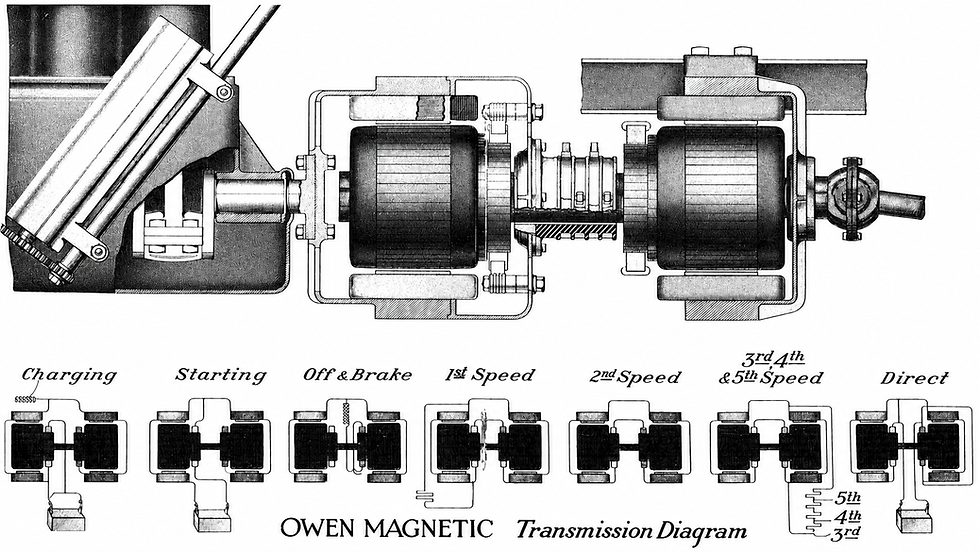
What followed was nearly two decades of patient, relentless refinement. Entz spent the early 1900s perfecting what he now called his electromagnetic transmission. The device he developed used a spinning magnetic field to drive a propeller shaft. By varying the intensity of that field, a vehicle could speed up, crawl or climb steep hills without a mechanical clutch or gearbox.

The elegance of it was almost structural. Instead of a series of metal gears clanging violently into place, you had a continuously variable flow of force, more like turning a dial than throwing a lever. The car didn't lurch. It glided.
Entz’s definitive patents described a masterfully integrated electromechanical system. It didn't just transmit power; it simultaneously charged the vehicle’s battery, provided automatic electric starting and enabled an early form of regenerative braking. When the driver wanted to slow down, the electric traction motor reversed its role to act as a generator, converting the car's forward momentum back into electricity while safely retarding the vehicle's speed. This is the exact principle found in every modern hybrid and electric vehicle sold today, taken completely for granted now but utterly revolutionary in the 1910s.
Entz understood the brilliance of what he had built. He just needed someone with the capital and connections willing to manufacture it.
The Owen Brothers Say Yes

By 1912, Walter C. Baker, an electric vehicle magnate in Cleveland with a sharp eye for elite technology, purchased the patent rights to the Entz transmission. He subsequently licensed it to Raymond Owen and his brother Ralph, who ran R. M. Owen & Company out of New York.
The Owen brothers were not engineers; they were legendary salesmen. They recognized the Entz electromagnetic transmission not as an engineering gimmick, but as the ultimate luxury experience. They targeted wealthy, refined buyers who found ordinary driving to be a loud, filthy nuisance and wanted a machine that felt less like operating heavy industrial machinery and more like being effortlessly carried.
They were entirely right about the audience. What they couldn't quite solve was the price.

This early 1916 advertisement shows an Owen Magnetic posed at an elegant estate entrance, perfectly matching the image the company wanted to project: quiet, refined, luxurious and almost effortless to drive.
The car that emerged from this collaboration, the Owen Magnetic, introduced to a stunned public at the 1915 New York Auto Show, was genuinely extraordinary. Its powerful six-cylinder gasoline engine drove a generator field bolted directly to the crankshaft. The generator transferred power across an open air gap using lines of magnetic force to an armature attached to the drive shaft. There was absolutely no mechanical connection between the engine and the rear wheels, making the Owen Magnetic one of the first true hybrid automobiles ever built.
Speed was controlled entirely by a small finger lever on a selector collar right in the center of the steering wheel. The experience was so smooth and intuitive that period automotive writers struggled to find vocabulary for it, frequently settling on words like "floating," "sailing" and "gliding through air."
"Driving a Melody"
Because the technology was invisible, Owen Magnetic's advertisements leaned heavily into poetic, experiential metaphors rather than the cold complexity of engineering. The result was one of the most artistic advertising campaigns of the early automotive age.

One famous ad compared driving the car to playing a musical masterpiece:
"If a great musician had to shift gears twice to get from treble to bass and throw his clutch out to change from flats to sharps, think how hampered he would be. He couldn't play a masterpiece. When you drive an Owen Magnetic you play a masterpiece... without the rigid hampering of gears or clutch."
That musical language resonated deeply with the era's elite. Enrico Caruso, the most celebrated operatic tenor in the world, famously bought a custom-built touring model. So did John McCormack, another legendary singer of international renown. There was something beautifully fitting about men who devoted their lives to the idea that the human voice should move without friction finding their way to a luxury brass era hybrid car built on exactly the same principle.

Busy executives also fell in love with the car's absolute lack of vibration. Commuters noted that the floating sensation was so perfect that they could comfortably use early Edison Business Phonographs to dictate correspondence to their secretaries while riding to work in stop-and-go city traffic, saving hours of time daily.
Luxury for the Few
But such effortless transportation came at a staggering cost. Depending on the year and custom coachwork body style, an Owen Magnetic cost between $3,000 and $6,500. At a time when a Ford Model T cost under $400 and the average American car sold for around $1,000, the Owen Magnetic was a monumental investment. It was explicitly marketed as the "Aristocrat of Automobiles."

About 974 Owen Magnetic automobiles were built over the car's production life, which wound through factories in New York, Cleveland under the Baker R&L Company and finally Wilkes-Barre, Pennsylvania, before the company entered receivership in 1920. A large British order, which saw a small number of chassis shipped to England to be finished and sold as "Crown Magnetics," was cut short when the Pennsylvania factory lines stopped moving for good in 1922.

The story of why the Owen Magnetic failed is not a story of faulty technology. The technology was exceptional. It was a matter of timing and economics. The automobile industry in the late 1910s was consolidating around mass production, standardization and mechanical simplicity. Entz’s electromagnetic transmission was a masterpiece of early engineering, but it required specialized, high-end electrical knowledge to service. The average country mechanic of the era couldn't begin to comprehend it. The costs of building it were high, and the market for an ultra-premium brass era hybrid automobile was, by definition, small.
The future was brilliant. The present simply couldn't afford it.
The Navy Noticed
There’s a detail about Entz’s career that says more about the structural integrity of his ideas than anything else: the United States Navy scaled his electromagnetic transmission concept up to power the battleship USS New Mexico, commissioned in 1918.
Following the success of the New Mexico, Entz spent much of the 1920s consulting on massive marine propulsion systems for major shipping lines, proving that a magnetic air gap could survive the violent, unpredictable torque of the open ocean far better than rigid steel gears.
Entz eventually retired to a quiet life in New Rochelle, New York, where he passed away on June 8, 1947, at the age of 79. In a cruel twist of historical irony, he died just six months before scientists at Bell Labs publicly demonstrated the very first solid-state transistor, the exact technological revolution in microelectronics required to finally make his complex hybrid ideas practical and affordable at a global scale.
The Machine from Tomorrow

The Tampa Bay Automobile Museum has long focused on unusual engineering, the kinds of machines that show how inventors once imagined entirely different futures for the automobile. In the Owen Magnetic, a six-cylinder gasoline engine turns a generator, which sends power to an electric motor at the rear wheels. There is no conventional clutch, no ordinary gearbox and no direct mechanical link between the engine and the drive wheels.

That is what makes the car feel so startlingly modern. It was not just a luxury automobile. It was an early attempt to make driving smoother, simpler and more refined, decades before hybrid technology became familiar to the public. The Tampa Bay Automobile Museum is home to three Owen Magnetic automobiles, making it one of the most important places in the world to see this rare chapter of early automotive experimentation.