
The Silent Knight Sleeve-Valve Engine and the Rare Cars It Powered
Updated: Jul 10
In the early 1900s, the automobile was still an open question. Steam cars, electric cars and gasoline cars all competed for the road. Engineers were still debating what the motorcar should be, how it should sound, how it should start, how far it should travel and even what kind of roads it deserved.
Gasoline cars had power and range, but they came with a problem: noise.
Their engines clattered, valves chattered and every mile carried the sound of metal working hard. Most motorists accepted the racket as part of the new machine. Charles Yale Knight did not.
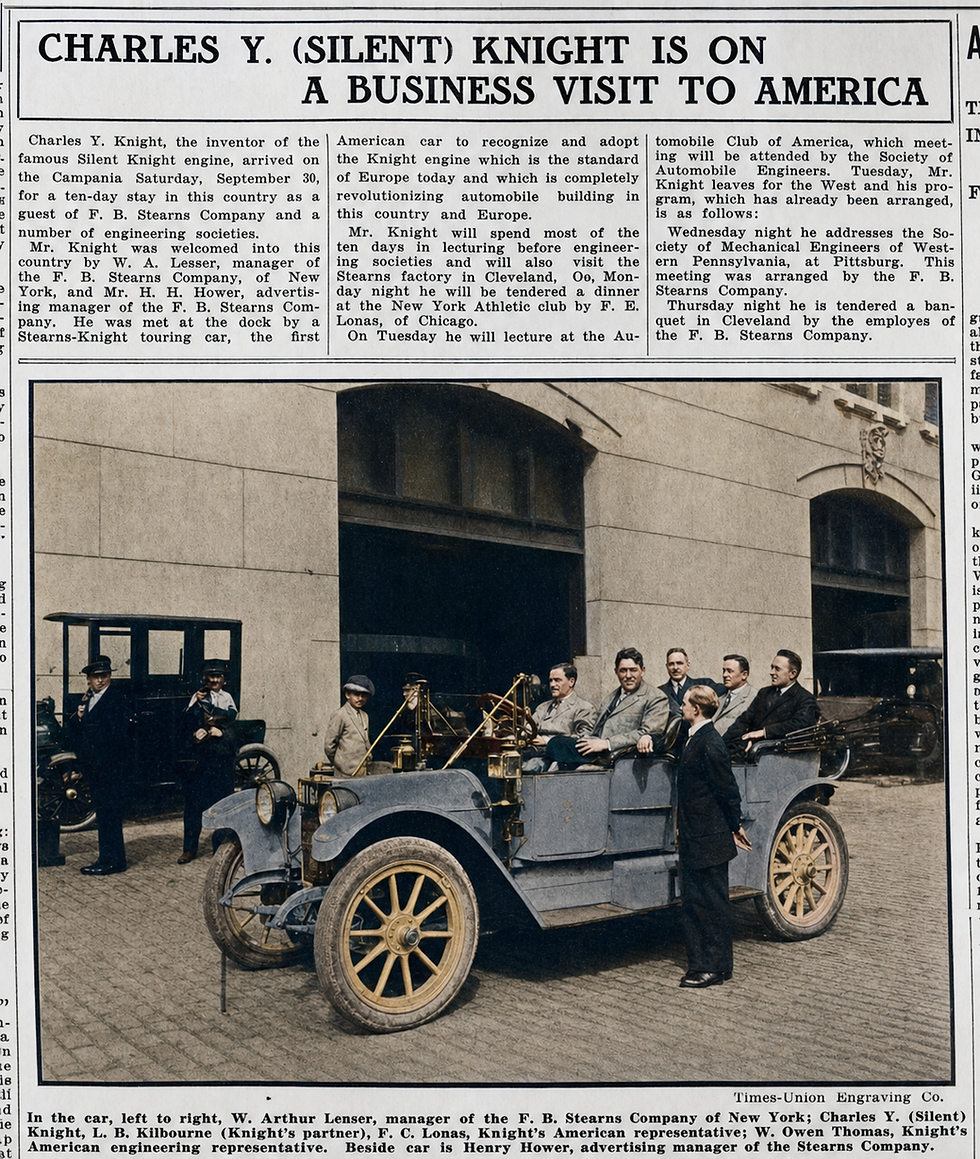
Knight believed the gasoline automobile could be powerful without being loud. His answer was one of the strangest and most ambitious engines of the early automotive age: the Silent Knight sleeve-valve engine.

Around the beginning of the 20th century, Knight bought an early three-wheeled Knox automobile. Its single-cylinder engine used conventional poppet valves, and the constant valve clatter sent him down an engineering rabbit hole.
He remembered something from his youth. On his father’s sawmill, he had once worked with a sliding valve mechanism, a device that could control flow without the snapping action of a poppet valve. That memory became the seed of a radical question: could a gasoline engine breathe through sliding sleeves instead of noisy valves?
Knight’s eventual design used two cast-iron sleeves inside each cylinder, one sliding within the other, with the piston moving inside the innermost sleeve. Small rods driven by an eccentric shaft moved the sleeves so their ports lined up with the intake and exhaust passages at just the right moments. With no ordinary valve train clattering overhead, the result was smoother, quieter and unlike almost anything else in early motoring.

Knight had created the Silent Knight engine.
The first complete Silent Knight car was Knight’s own prototype touring car, shown at the 1906 Chicago Auto Show. But American manufacturers were cautious. The engine was unconventional, expensive to build and demanded careful lubrication. Rather than give up, Knight took his idea across the Atlantic.
At the Tampa Bay Automobile Museum, four rare cars trace what happened next: the journey of one inventor’s quiet engine from rejected idea to international engineering movement.
England Says Yes: 1909 Daimler TB22
Knight’s breakthrough came in England with Daimler. Daimler brought Knight to Coventry and worked to refine the sleeve-valve engine for production. By 1908, the reworked engine was ready for public attention. To period observers, it seemed to remove an entire chorus of noisy parts: mushroom valves, springs, tappets and cams. The promise was almost startling by Edwardian standards. An engine could be powerful without sounding busy.

But Daimler knew silence alone would not convince skeptics. The engine had to prove it could survive. So in 1909, Daimler submitted two Knight engines to a demanding Royal Automobile Club-supervised trial. The engines ran for 132 hours on the test bench, were installed in a touring car for a 2,000-mile run at Brooklands, then were tested again afterward. Daimler was so confident in the result that it challenged rival manufacturers to match the performance.
For Knight, this was vindication. The engine American manufacturers had hesitated to adopt had passed one of the most important public trials in motoring.

By late 1909, Daimler had turned the Silent Knight into more than an engineering announcement. It became a public event. The Bystander described a “Daimler Day,” with guests carried by special train to Coventry to inspect the company’s enormous works. The quiet engine had become a loud success.

The museum’s 1909 Daimler TB22 is a remarkable survivor from that moment. It is an open two-seat car with an additional dickie seat for two more passengers. It is the only known complete surviving TB22 and the only known vehicle still carrying a Hewers body. Because the TB22 was the first Daimler model fitted with the Knight sleeve-valve engine, this car may be one of the oldest surviving sleeve-valve Daimlers in existence.
The Daimler also shows how different early driving was. It has rear-wheel brakes only, a leather cone clutch, a four-speed crash gearbox, manually controlled engine lubrication, hand advance and retard for spark timing, no starter motor and a central accelerator pedal. It cruises around 35 mph and takes real skill to drive.
The Idea Comes Home: 1913 Stearns-Knight SK6
Daimler’s success did not go unnoticed in the country that had first hesitated to embrace Knight’s engine.

In Cleveland, Ohio, Frank B. Stearns had already built a reputation for large, powerful, high-quality automobiles. He had started early, building his first car as a teenager, then founding F. B. Stearns and Company in 1898. By 1912, Stearns became the first American manufacturer to license the Knight sleeve-valve engine. Under the licensing agreement, the cars carried the Knight name.
The result was Stearns-Knight.
Period advertising framed Stearns-Knight as part of a global campaign against poppet valves. A 1912 advertisement described a “world-wide effort to get rid of poppet valves,” placing Stearns alongside Daimler, Mercedes, Panhard and other major manufacturers using Knight-type engines. The same advertising promoted the car’s silent power, smoothness and freedom from conventional valve trouble.

The museum’s 1913 Stearns-Knight SK6 represents the height of that ambition. Large, expensive and powerful, it was advertised as “America’s Most Luxurious Motor Car.” With a six-cylinder Silent Knight engine, the SK6 paired quietness with speed, a rare combination in the Brass Era.
A 1912 advertisement announced, “The Stearns-Knight Six Is Here,” calling the six-cylinder model the next step in the company’s development. A 1913 advertisement described the car as “A Combination of Two Great Principles”: Stearns construction and the Knight sleeve-valve motor.
For museum visitors, the SK6 is Knight’s idea returning home in triumph. The same kind of engine American manufacturers had once doubted was now powering one of the most prestigious cars in the United States.
It was not just quiet. It was grand, costly and built to impress.
The Idea Becomes Architecture: 1927 Avions Voisin C7
By the 1920s, Knight’s engine had traveled far beyond its inventor’s hands. It had been licensed around the world and each manufacturer gave it a different character.

Nowhere did it take on a more unusual personality than in France, where Gabriel Voisin built cars with the mind of an aviation pioneer.
Voisin was not simply an automaker. Before automobiles, he built aircraft. His company, Société des Aéroplanes G. Voisin, became a major French aircraft producer during World War I. After the war, Voisin turned to automobiles, but he carried aircraft thinking with him: lightness, visibility, balance and structural honesty.

The museum’s 1927 Avions Voisin C7 shows how different a Silent Knight car could become in another designer’s hands. A period Voisin sales pamphlet lists the Type C.7 Long as a 10 CV chassis with a moteur sans soupapes, literally an engine without poppet valves. It used a four-cylinder monobloc sleeve-valve engine with a 67 mm bore and 110 mm stroke, electric lighting, a single-disc clutch, three forward speeds and four-wheel brakes.

The C7 was not only quiet. It was conceived as a complete modern object. Voisin bodies were known for sharp geometry, large windows and aircraft-inspired logic. The C7’s Lumineuse body style, meaning luminous or full of light, turned the closed car into an airy cabin. Its narrow roof, generous glass and carefully balanced proportions set it apart from the heavy formal sedans of its era.

A historic Voisin photo in the museum files captures that architecture clearly: a tall glassy passenger compartment, upright body and unusual proportions that make the car look more like a modern room on wheels than a traditional carriage.
Where Daimler used the sleeve-valve engine to prove quiet luxury and Stearns-Knight used it to create American prestige, Voisin turned it into part of a larger design philosophy.
The Idea Reaches Main Street: 1928 Willys-Knight Model 56
If Stearns-Knight made the sleeve-valve engine prestigious, Willys made it familiar. Willys-Overland built more Knight-engined cars than any other manufacturer, taking the idea out of the luxury showroom and placing it in front of ordinary American buyers.

The museum’s 1928 Willys-Knight Model 56 shows what that looked like: a practical family sedan sold on smoothness, silence, durability and value.
The Model 56 was introduced in January 1928 as the new lower-priced Willys-Knight Standard Six. It used a six-cylinder sleeve-valve engine rated at 45 horsepower at 3,000 rpm, with a 2-15/16 x 3-7/8 inch bore and stroke, a 5.5:1 compression ratio, seven main bearings and a 109.5-inch wheelbase. Production totaled 35,856 cars in Toledo plus 2,075 in Canada, matching the museum’s total of 37,931.

Willys advertised the car heavily. A 1928 newspaper ad introduced the new Willys-Knight Standard Six as being “brought within reach of added thousands” at $1,145. Later that year, another ad promoted the Standard Coach at $995, promising “smoothness, silence and power” at record low prices.
But Willys also had to deal with the sleeve-valve engine’s most persistent weakness: oil consumption and smoke. Sleeve-valve engines needed lubrication around their moving sleeves. Willys answered with a patented oil rectifier, a system designed to separate fuel contamination from engine oil and return cleaner oil to the crankcase. Period Willys material stressed the importance of proper lubrication and warned that gasoline or kerosene could dilute motor oil and destroy its lubricating qualities.
That rectifier makes the Willys-Knight especially important. Charles Knight invented the sleeve-valve principle. Willys worked to make it practical for everyday American drivers.
The Last Chapter: 1938 Panhard Dynamic
Introduced at the Paris Motor Show in October 1936, the Panhard Dynamic was one of the boldest cars of its time. Designed by Louis Bionier, it wrapped advanced engineering in dramatic Art Deco bodywork, with sweeping lines, deeply sculpted fenders and repeating cast-aluminum details.

The Dynamic used an electrically welded steel unibody, fully independent front suspension with torsion bars and hydraulic shock absorbers, a double-circuit hydraulic braking system with twin master cylinders and a 4-speed manual transmission with a free-wheel feature. At the heart of it was something even more remarkable: a Knight sleeve-valve six-cylinder engine.

By this point, Panhard had refined the Knight principle far beyond its early form. The sleeves were light steel components, the carburetion was Panhard-designed and the car used a Dynastart starter-generator mounted directly on the crankshaft, all in the service of smoother, quieter operation.
Its broad cabin, advanced construction and flowing Art Deco styling made it a luxury car for the modern age. Museum correspondence notes that very few Dynamics survive today, and that this example may be the only one in the United States.

The 1938 Panhard Dynamic represents the final production chapter of the Knight sleeve-valve automobile. If the 1909 Daimler TB22 shows where the Silent Knight story took hold, the Dynamic shows where it ended: fully refined, deeply modern and housed in one of the most striking cars of the prewar era.
What Became of the Silent Knight?
The Silent Knight engine did not win in the end. Conventional poppet-valve engines improved, manufacturing priorities changed and the sleeve-valve engine’s appetite for oil became harder to justify. By the early 1930s, most manufacturers had moved on, though a few European makers continued to develop sleeve-valve cars for a time.
See the Silent Knight Cars in Person
The Tampa Bay Automobile Museum preserves the engineering roads not taken, the inventions that challenged convention and the stories of people who believed machines could be built differently.

Plan your visit to the Tampa Bay Automobile Museum and discover how one inventor’s search for silence changed automotive history.