
The Brass Era: Early American Automobiles
Updated: May 20
At the end of the nineteenth century, American cities were loud, crowded and alive with competing kinds of motion. Horses pulled delivery wagons and hansom cabs. Electric trolleys ran on fixed rails. Elevated trains rumbled overhead. Bicycles darted through whatever gaps remained.
It was a world that had taken decades to organize itself around animal power, rail lines and human effort. Then, in the span of a few years, that world began to change.
Steam, electricity and gasoline all presented themselves as the future at the same time. The era that followed, roughly 1896 to 1915, is known today as the Brass Era, named for the gleaming brass fittings that adorned those early machines: the lamps, the horns, the radiator caps catching the light on unpaved roads. It was a moment when the automobile was still being invented, argued over and imagined in several different directions at once. Nobody yet knew which direction would win.
The Road Before the Car: The Bicycle Craze
The bicycle craze of the 1890s did more to prepare America for the automobile than it usually gets credit for. The safety bicycle, with its pneumatic tires, chain drive and lighter frame,spread quickly and became a national obsession. It also created one of the first organized groups demanding better roads. The Good Roads Movement reshaped how Americans thought about public infrastructure long before gasoline engines made that infrastructure essential.

One standout name was E. C. Stearns & Co. of Syracuse, New York, best known for its bright yellow “Yellow Fellow” bicycles. Edward C. Stearns built his reputation during the 1890s bicycle boom, when lightweight construction, precision metalwork and better handling made the bicycle feel like the machine of the future.
Edward C. Stearns built his reputation on lightweight construction, precision metalwork and machines that ordinary people actually wanted to ride. Within a decade, that same manufacturing culture had pivoted to steam carriages. The horses had quietly disappeared from the names of his vehicles, but the craftsmanship remained.
Across America, the factories and workshops that had built bicycles began turning toward automobiles. They carried with them exactly the right skills: lightweight construction, precision parts and an instinct for what everyday people wanted from a personal machine. The bicycle had not just prepared the roads. It had helped build the industry.
Steam: The Familiar Future
Americans already understood steam. Locomotives had been reshaping the country for half a century. Factories ran on it. Ships crossed oceans with it. A steam automobile felt less like a leap into the unknown.

Locomobile was among the first to make that case at scale. Around 1899 and 1900, it produced steam-powered vehicles that looked like light carriages that had simply misplaced their horses. The company later moved into gasoline, but its early reputation was built on steam and its commercial success helped prove that Americans were ready to buy an automobile, whatever it ran on, as long as it worked.

Stanley made the more lasting impression. Stanley steam cars were known for smooth, quiet power and a performance that regularly surprised drivers who assumed gasoline was automatically the faster or more sophisticated technology. On open roads, a Stanley could hold its own against almost anything with a combustion engine. The quiet was particularly striking, a quality that gasoline cars would not match for decades.
The Electric Moment
At the turn of the twentieth century, electric cars had real advantages in crowded cities. They were quiet, clean, easy to operate and far less likely to frighten horses than the rattling, backfiring alternatives. For urban buyers, especially wealthy ones, the electric vehicle made a compelling case.
Andrew L. Riker had been thinking about electric motors since his teenage years in the 1880s, when he built an electric tricycle in Brooklyn. By the late 1890s, he was helping prove that electric power was not simply polite and refined — it could also be fast. In 1896, a Riker electric vehicle won one of the first automobile races on an American track, at Narragansett Park in Rhode Island, beating a gasoline-powered competitor and challenging easy assumptions about which technology was more capable.

Columbia Electric Vehicles, built through the Hartford-based world of Pope Manufacturing, turned that logic into a luxury proposition. Columbia’s electric runabouts, victorias and broughams were aimed at wealthy urban buyers who cared more about refinement than range. The cars were beautifully finished and socially acceptable in ways that early gasoline automobiles simply were not.

The Milburn Wagon Company of Toledo, Ohio arrived at the electric automobile from the opposite direction. Milburn had been building horse-drawn vehicles when it pivoted to electric cars in 1915, and the transition was more natural than it might appear. The enclosed body styles of the Milburn Electric still echoed the coach house, while the company’s carriage-making instincts showed in the finish of the interiors. The Milburn was quiet, clean and easy to operate. It was best suited to short urban trips, where battery range did not become a serious problem.

The Gasoline Argument
Gasoline cars were loud, oily and temperamental. Early starting mechanisms required physical strength and sometimes punished the driver when they misfired. These cars frightened horses, offended neighbors and demanded more mechanical patience than many buyers wanted to give. They were, by almost any measure, the least pleasant option on the road.
And yet gasoline kept gaining ground and the reason was range.

Alexander Winton made that argument as dramatically as anyone. In 1899, he drove one of his own gasoline automobiles from Cleveland to New York City, a journey of over five hundred miles that took ten days and generated enormous newspaper coverage. The point was hard to miss: gasoline could go distances that steam and electric vehicles struggled to match. Whatever its drawbacks, it could take you somewhere.

The real market shift came with Oldsmobile. Introduced in 1901, the Curved Dash Oldsmobile was not the most refined or powerful car available. It was one of the first genuinely affordable and popular American gasoline automobiles. Ordinary buyers could consider it, not just wealthy enthusiasts.
That made the Curved Dash Oldsmobile a hinge point in the American automobile story. It was the moment the machine began to stop being a marvel and start being a product.
The Dissenters and Experimenters

Even as gasoline gained ground, the industry remained experimental. Some of its most interesting figures refused to follow the emerging consensus.
The H. H. Franklin Manufacturing Company of Syracuse had its own theory of what an automobile should be. While many manufacturers moved toward heavier, water-cooled engines, Franklin spent three decades arguing for air cooling and light weight. The company built its first motorcar in 1902 and continued until 1934.
The 1905 Franklin Model F Touring and 1917 Franklin 9A are are the physical expression of a sustained engineering argument.

Elmore Manufacturing Company of Clyde, Ohio came to automobiles through bicycles. It built its reputation on a two-stroke engine that eliminated conventional valves entirely, then advertised that fact with a slogan: “The Car With No Valves.” It was a genuinely different approach to the problem of the internal combustion engine, and for a time it found buyers who appreciated the difference.
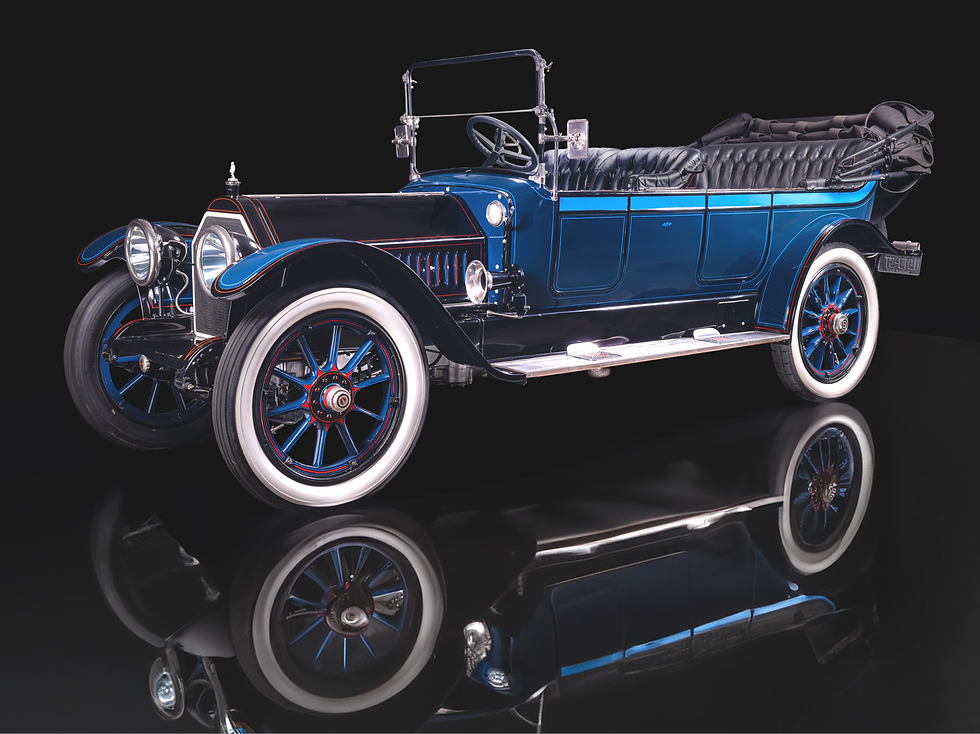
The F. B. Stearns Company of Cleveland took a different path, building toward luxury rather than simplicity. Frank Stearns assembled his first automobile in his family’s basement as a teenager. By 1912, his company had become the first American manufacturer to license the Knight sleeve-valve engine, a British design prized above all for silence.
In an era when many gasoline automobiles announced themselves from two blocks away, the Stearns-Knight moved with unusual quiet. The 1913 Stearns-Knight SK6 represents the automobile at its most aspirational: not simply transportation, but a demonstration of what precision engineering could feel like in motion.

The most forward-looking experiment may have been the Owen Magnetic, produced beginning in 1915. Built by R. M. Owen & Company in New York, it used a six-cylinder gasoline engine not to drive the wheels directly, but to power a generator. That generator worked through an electromagnetic transmission, with no direct mechanical connection between the engine and the driveshaft. It was a hybrid powertrain in everything but name, an approach the industry would not seriously return to for generations. The Owen Magnetic was searching for something smoother, more controllable and more refined than what combustion alone could deliver. It was, in retrospect, searching for the future.
The Parade and the Show
On November 4, 1899, the Automobile Club of America organized a parade through downtown Manhattan. Edison cameras captured the scene. In the footage, steam cars, electric vehicles and early gasoline automobiles move through streets still shared with cyclists, pedestrians, horse-drawn wagons and hansom cabs. No single technology dominates the frame. The city looks exactly like what it was: a place suspended between two eras, not yet sure which one it was becoming.
The following year, the first New York Auto Show filled Madison Square Garden with 69 exhibitors and more than 48,000 visitors. Electric, steam and gasoline automobiles appeared on the floor side by side. Parts vendors set up beside manufacturers. Curious New Yorkers walked between machines that ran on incompatible principles and represented competing visions of the future.
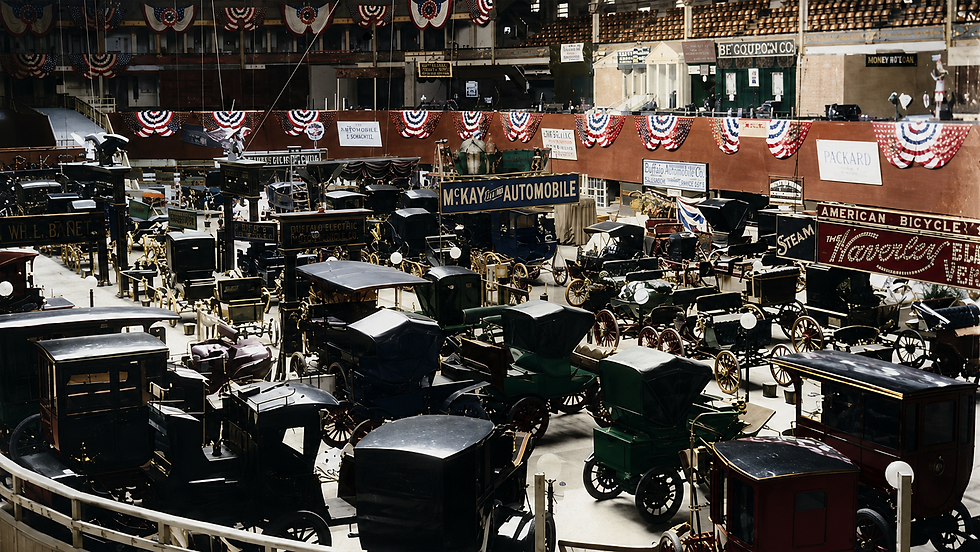
Nobody in that building knew what American roads would look like in twenty years. That uncertainty is the thing most worth recovering about the Brass Era. The automobile did not arrive as a foregone conclusion. It arrived as a set of open bets, on steam, on electricity, on gasoline, on air cooling, on sleeve valves, on electromagnetic transmissions. The people who built and bought those first cars were improvising, arguing and experimenting in real time.
What the Machine Age Inherited
The gasoline automobile eventually won, and it won decisively. Yet the road from the Gilded Age to the Machine Age was not a march toward the inevitable. It was a period of improvisation, full of brilliant ideas, strange detours and machines that came remarkably close to carrying the future in a different direction.
The Machine Age inherited the gasoline car. But it also inherited the roads, the manufacturing culture, the engineering vocabulary and the restless appetite for mechanical possibility that bicycles, steam engineers, electric pioneers and gasoline experimenters had spent decades building together. The brass fittings are long gone from American automobiles. The spirit that made them gleam has never entirely disappeared.
Explore the machines that shaped America’s road to the modern age at the Tampa Bay Automobile Museum.